Concierge Medicine Software for Better-Prepared Patient Visits
Concierge physicians are expected to know the patient beyond the latest chart entry. Bioscope.ai brings genomics, biomarkers, microbiome findings, laboratory trends, medical history and other available clinical context into one physician-facing view before the conversation begins.
Instead of spending valuable appointment time reconstructing the patient story, physicians can begin with relevant findings organized for review and supporting evidence available for closer examination. The result is a more prepared consultation without removing clinical judgment or professional responsibility from the physician.

Deliver the Preparation High-Touch Care Requires
Concierge patients often bring more than a single complaint. Their care may involve years of records, results from several laboratories, specialist reports, medications, family history, lifestyle information, wearable data and questions about prevention or long-term health.
Each source can add useful context, but reviewing everything separately makes preparation slower and increases the chance that an important relationship is overlooked.
Bioscope.ai helps reconcile available information before the visit and organizes it within a clinician-facing record. A laboratory change can be reviewed beside medication history. A genomic finding can be considered with family history, current health and supporting literature. Microbiome information can be examined alongside symptoms and other relevant results when those capabilities are available in the patient's platform tier.
This gives the physician a structured starting point. It does not determine what is clinically relevant or make a diagnosis. It makes the patient context easier to review so the physician can focus on interpretation, communication and the decisions that require professional judgment.
Begin the Visit With a Clear View of the Patient
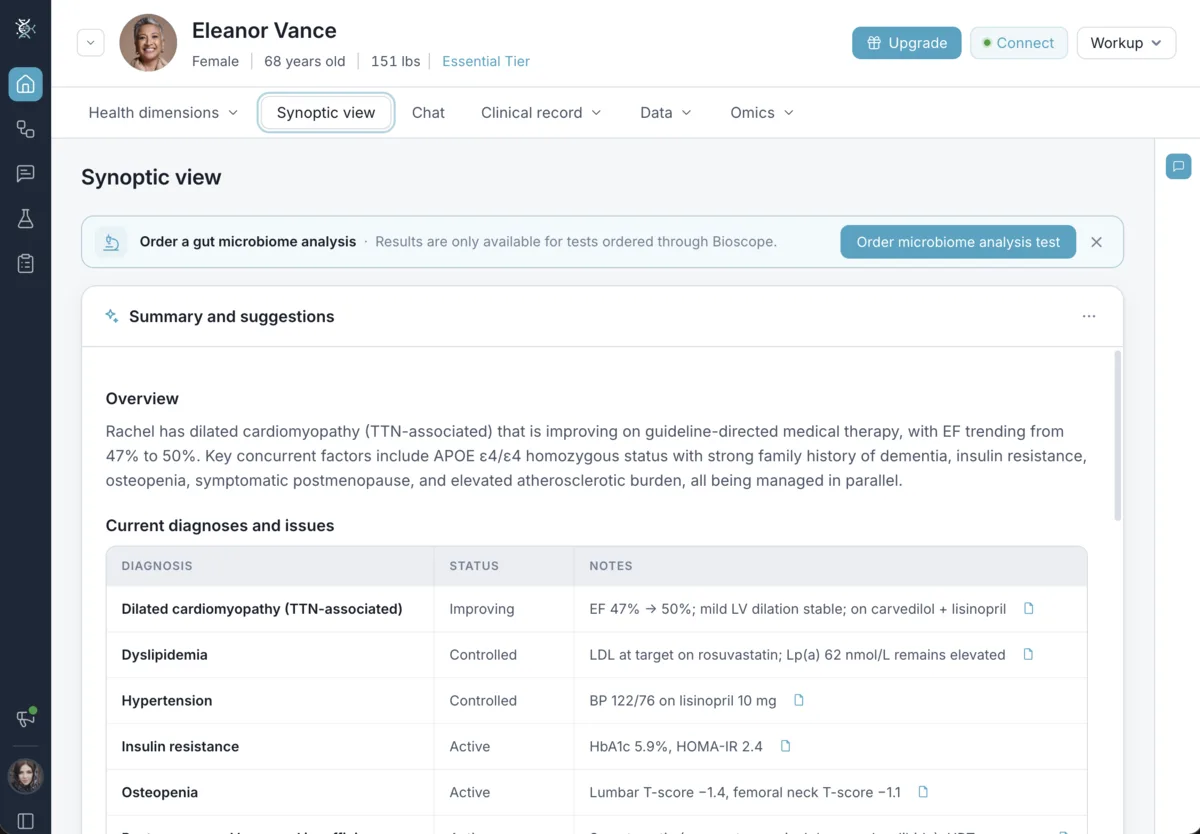
The Bioscope.ai Synoptic Dashboard presents available patient information across 15 health dimensions.
Areas such as cardiovascular, metabolic, renal, hepatic, immune, gastrointestinal, neurocognitive and longevity health can be reviewed from one high-level view. Visual indicators help the physician identify where closer examination may be useful.
From the dashboard, physicians can move into related metrics, records, medical images and supporting science. The purpose is not to reduce a patient to a score. It is to make a complex record easier to navigate and help the physician decide where attention is most valuable before and during the consultation.
For a concierge practice, this can support a more confident opening to the visit. The physician is less dependent on searching across separate reports, while the patient experiences a conversation informed by a broader view of their history and current data.
Explore Complex Questions With Evidence Attached
Concierge consultations frequently move beyond standard questions. Patients may want to understand how a recent laboratory trend relates to their history, whether a genomic result deserves further review or which changes should be monitored before the next appointment.
Bioscope.ai includes a conversational clinical interface for exploring the information available in the patient record.
Physicians can ask focused questions, review the context used in the response and examine citations to supporting literature when provided. This creates a faster route from a broad patient profile to the details that may matter for the conversation.
The platform acts as an AI clinical colleague, not an autonomous decision-maker. Responses require physician evaluation, and the qualified physician remains responsible for interpretation, diagnosis, treatment and patient guidance.
Bring Advanced Testing Into the Patient's Broader Story
Advanced testing is most useful when it can be interpreted within the full patient context.
Eligible Bioscope.ai tiers include Bioscope-ordered 30x whole-genome sequencing, advanced polygenic risk scores and microbiome capabilities. Platform availability and testing costs depend on the selected tier and applicable order.
Bioscope.ai can review eligible genomic and microbiome information alongside laboratory findings, medications, medical history and other available data. Third-party omics reports may also be uploaded for contextual use in AI chat, while remaining separate from dedicated Bioscope omics-analysis tabs.
This distinction matters for concierge medicine. A genomic or microbiome result should not stand alone as a conclusion. It becomes more useful when the physician can evaluate it against the patient's history, current health, environment, lifestyle and other evidence.
See Bioscope.ai in a Concierge Workflow
Walk through a sample concierge workflow, from patient information and advanced testing to physician review.
Schedule a DemoMaintain Continuity Between High-Value Visits
Concierge care is an ongoing relationship. The clinical picture can change between appointments as new laboratory values, records and supported wearable signals become available.
Bioscope.ai can help organize these updates and surface changes that meet predefined thresholds for physician review.
Supported information may include sleep, steps, heart rate, heart-rate variability, oxygen saturation, activity, weight and body-fat percentage, depending on the connected service and available integration.
Wearable information adds longitudinal context. It is not diagnostic and should be interpreted with the rest of the patient record.
Bioscope.ai can also re-evaluate patient information as relevant databases and scientific evidence change, with material updates available for physician attention.
This supports continuity without requiring the physician to manually repeat the same broad review every time new information arrives.
Add Clinical Intelligence Without Replacing Your EMR
A concierge practice should not have to abandon an established clinical system to work with richer patient context.
Bioscope.ai is designed to operate alongside existing workflows and can integrate with many EMRs, subject to the applicable configuration and order.
The platform adds a layer for connected clinical review across records, genomics, microbiome findings, biomarkers and other supported information.
Bioscope.ai can also draft encounter notes and patient summaries from available visit information. Physicians review, edit and attest drafts before they become part of the clinical record.
Bioscope Connect provides basic web and mobile access for information a physician chooses to share, including reports and visit summaries.
This gives the practice a more organized way to continue communication while preserving the physician's role in explaining complex findings.
Keep the Physician in Control
Bioscope.ai is built to support physician-led care.
AI-generated programs, summaries and record-based responses remain subject to professional review. Findings from genomics, microbiome analysis, polygenic risk scores, wearables and other sources are not diagnoses and must be evaluated in the context of the individual patient.
Bioscope.ai maintains a separate set of security and compliance resources, including its HIPAA framework, Business Associate Agreement and documentation for EHR and lab-processing integrations, available for practices that need to review them.
Any final marketing language describing HIPAA compliance, data ownership, data sharing or privacy commitments should be approved by Bioscope.ai's compliance or legal contact before publication.
Give Every Concierge Consultation Greater Clinical Depth
Bioscope.ai helps concierge physicians prepare for complex visits with a clearer view of the patient before the appointment begins.
The Synoptic Dashboard organizes available information across key clinical dimensions. The conversational interface supports focused exploration with evidence available for review. Eligible genomics and microbiome capabilities add biological context, while EMR connectivity, monitoring and documentation tools help the practice maintain continuity.
Together, these capabilities support a high-touch patient experience without turning the platform into the practitioner.
The physician remains responsible for clinical interpretation and care, while Bioscope.ai helps make the growing volume of patient information more organized, accessible and useful.
Bring Bioscope.ai Into Your Concierge Practice
A personalized walkthrough covers patient preparation, EMR integration, platform tiers and the clinician-facing workflow.