Integrative Medicine Software for Connected Clinical Review
Integrative care often requires physicians to consider information from many parts of the patient's health story. Laboratory findings, medical history, medications, symptoms, lifestyle information, genomics and microbiome results may all contribute useful context, but they are rarely presented in one coherent view.
Bioscope.ai helps integrative medicine physicians bring available patient information into a connected, physician-facing workflow. Rather than reviewing each report in isolation, clinicians can examine relationships across the patient record and decide what deserves closer attention.
The platform supports clinical review. It does not replace the physician's responsibility to interpret findings, make diagnoses or determine care.
Bring Disconnected Health Information Into One Clinical Picture
Integrative medicine practices frequently work with patient information collected at different times, for different purposes and through different systems.
A medical record may document diagnoses and medications. Laboratory reports may show current biomarker levels. Genomic findings may indicate inherited characteristics that require clinical context. Microbiome results may add another biological layer. Symptoms and lifestyle information can provide further perspective.
When these inputs remain separated, the physician must reconstruct the patient picture manually.
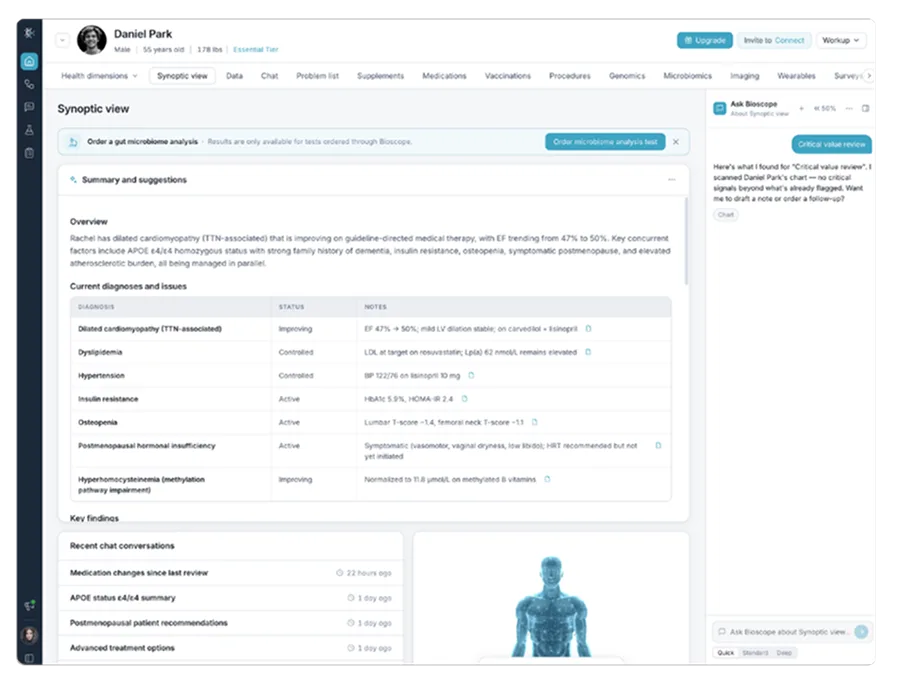
Bioscope.ai helps consolidate available information into an organized patient record. Physicians can review different data sources together instead of moving repeatedly between reports, portals and disconnected documents.
This creates a clearer foundation for integrative clinical review. It does not assume that every data point has equal importance. It gives the physician a practical way to examine the information and apply professional judgment.
Review the Patient by Clinical Dimension, Not by Data Source
Separate reports are usually organized around the test that produced them. Physicians, however, need to understand how different findings may relate to the patient.
The Bioscope.ai Synoptic Dashboard organizes available information across 15 health dimensions. These include cardiovascular, metabolic, renal, hepatic, immune, gastrointestinal, neurocognitive and other areas of health.
Visual indicators provide an at-a-glance view of areas that may warrant closer examination. Physicians can then move from the summary into relevant metrics, records, medical images and supporting science.
This approach changes the starting point of the review. Instead of asking what each individual report says, the physician can examine what the combined information may mean within a specific clinical dimension.
The dashboard is designed to make complex patient information easier to navigate. It does not provide a diagnosis or remove the need for qualified clinical interpretation.
Examine Relationships Across the Patient Record
Integrative medicine often depends on understanding context.
A laboratory result may need to be considered alongside symptoms, medication history and previous trends. A genomic finding may have limited meaning without the patient's family history and current health. Microbiome information may require consideration alongside gastrointestinal symptoms, laboratory findings and other clinical evidence.
Bioscope.ai includes a conversational clinical interface that allows physicians to explore the information available in the patient record.
Physicians can ask focused questions about findings, changes and possible relationships. Responses can be connected to the patient's available information and include citations to supporting literature when provided.
This allows the physician to examine both the response and the evidence behind it.
The AI interface is a tool for clinical exploration. It does not independently determine whether a relationship is clinically meaningful. The physician remains responsible for evaluating the evidence and deciding how it applies to the individual patient.
Add Genomic Context Without Isolating It From the Patient
Eligible Bioscope.ai tiers include Bioscope-ordered 30x whole-genome sequencing and advanced polygenic risk scores.
Whole-genome sequencing provides broader coverage than limited genetic panels, but a larger amount of genomic information also creates more complexity. A finding should not be interpreted separately from medical history, current health, environment and other relevant evidence.
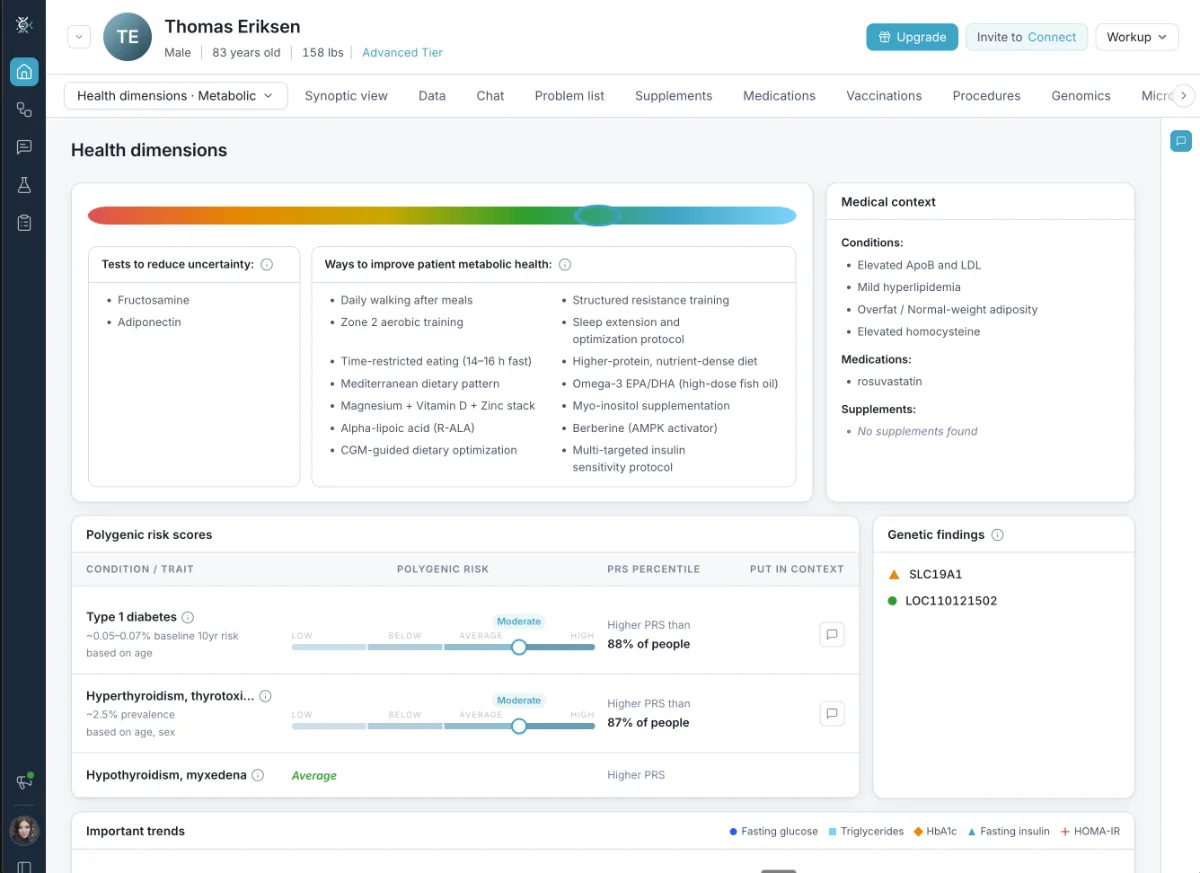
Bioscope.ai helps physicians review eligible genomic information alongside laboratory findings, medications and available clinical context.
This makes genomic information part of the broader patient review rather than a separate report that must be interpreted on its own.
Advanced polygenic risk scores provide population-calibrated estimates across supported conditions. They are not diagnoses or predictions of an individual outcome. They require interpretation by a qualified physician together with the patient's clinical and personal context.
Integrate Microbiome and Multi-Omic Information Responsibly
Eligible platform tiers support microbiome testing and analysis.
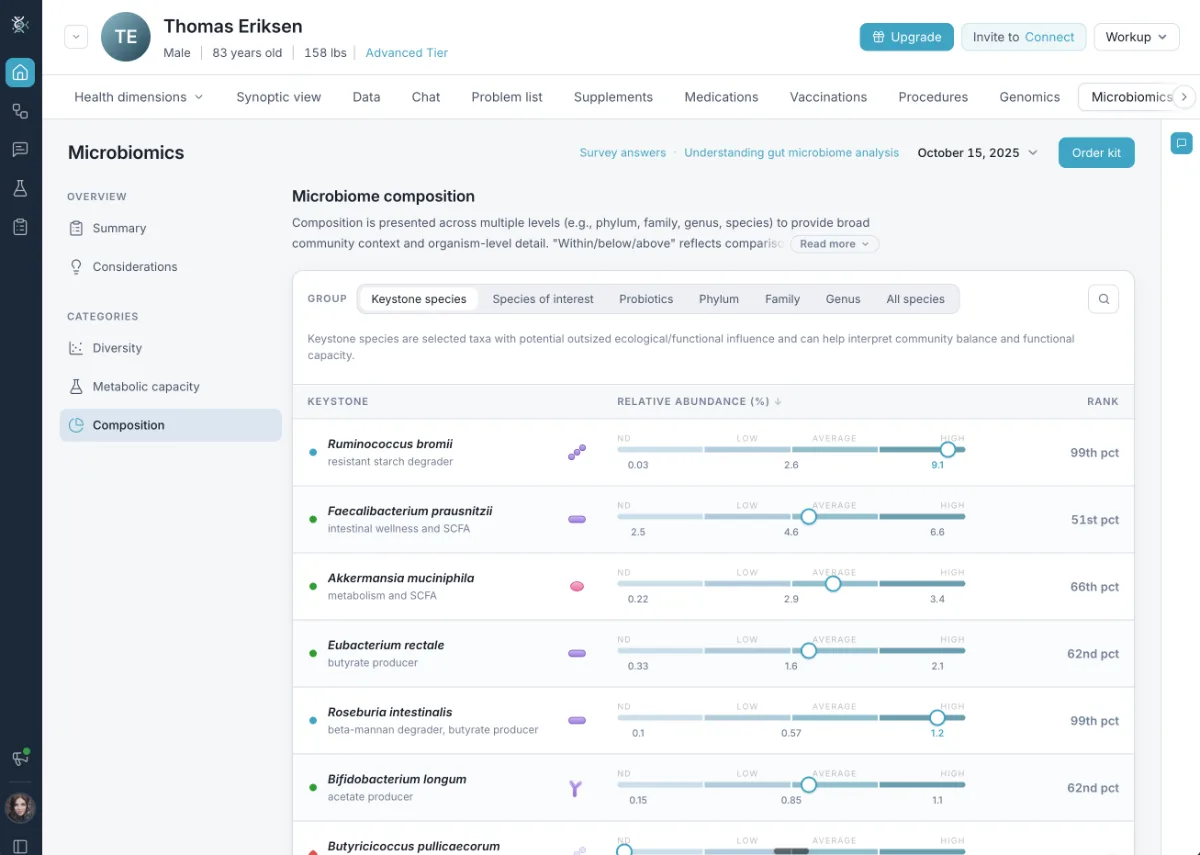
Microbiome findings can add another source of information to an integrative review, particularly when they are examined alongside symptoms, laboratory results, medical history and genomic context.
Bioscope.ai can integrate, analyze and visualize eligible Bioscope-ordered genomics and microbiome data. This helps physicians examine different biological layers within a more organized framework.
Third-party omics reports may also be uploaded for contextual use in AI chat. These reports remain separate from the dedicated Bioscope omics-analysis tabs.
This distinction prevents uploaded reports from being represented as if they had received the same platform-specific processing as eligible Bioscope-ordered tests.
Microbiome and multi-omic information should not be treated as a standalone clinical conclusion. Bioscope.ai helps make the information available for structured physician review while preserving the need for professional interpretation.
Explore a Connected Integrative Workflow
See how Bioscope.ai brings patient records, laboratory findings, genomics and microbiome information into one physician-facing clinical view.
Schedule a DemoAlign AI Support With the Way You Practice
Integrative medicine is not practiced through one universal framework. Physicians may use different clinical guidelines, evidence standards and judgment factors when reviewing complex patient information.
The Bioscope.ai Clinical Decision Framework allows physicians to encode elements of how they practice.
This can include relevant guidelines, clinical patterns and judgment factors that influence how the physician reviews the patient's information.
The framework helps AI support remain more closely aligned with the physician's clinical approach. It does not give the platform authority to practice medicine or make independent decisions.
The physician remains responsible for reviewing the available evidence, determining clinical relevance and deciding what should be discussed or considered with the patient.
Create a Structured Starting Point for Health Optimization
Bioscope.ai can produce AI-guided health optimization programs based on the patient information available to the platform.
These programs provide a structured starting point for physician review. They can be examined, edited and approved before being shared.
This is particularly relevant to integrative practices that need to consider several aspects of the patient's health within one coordinated plan.
The platform can help organize the available context, but it does not automatically determine the appropriate intervention. Physicians decide whether any element is relevant, appropriate and supported for the individual patient.
This workflow gives the practice a way to move from fragmented information toward a more organized physician-led plan without removing professional oversight.
See How Bioscope.ai Adapts to Your Clinical Approach
Review the Synoptic Dashboard, Clinical Decision Framework and physician-guided optimization workflow in a personalized demonstration.
Schedule a Personalized DemoWork Alongside Your Existing Clinical Systems
Bioscope.ai is designed to add connected clinical intelligence without requiring a practice to replace its existing EMR.
The platform can integrate with many EMRs, subject to the applicable configuration and order. Available patient context can be brought into the Bioscope.ai environment for more organized clinical review.
Physicians can continue using their established clinical system while adding a connected view of genomics, microbiome information, biomarkers, records and other supported data.
Bioscope.ai can also draft encounter notes and patient summaries from available visit information. Physicians review, edit and attest drafts before they enter the clinical record.
This helps the practice maintain a physician-controlled documentation process while reducing the need to rebuild the same patient context across separate systems.
Keep Evidence and Professional Responsibility Visible
Integrative care can involve information with different levels of evidence, clinical relevance and uncertainty.
Bioscope.ai is designed to keep supporting literature available when citations are provided, allowing the physician to review the basis for a response or finding.
The platform supports evidence-grounded exploration without presenting AI output as an independent medical conclusion.
Genomic findings, microbiome results, polygenic risk scores, AI-generated programs and other platform outputs require qualified physician evaluation. They should be considered together with medical history, current health, medications, lifestyle, environment and other relevant evidence.
For details on data protection, HIPAA-related practices and applicable service agreements, Bioscope.ai maintains dedicated security and legal documentation covering its platform, EHR connections and laboratory-processing services.
Build a More Connected Integrative Medicine Workflow
Bioscope.ai helps integrative medicine physicians bring fragmented patient information into a more coherent clinical view.
The Synoptic Dashboard organizes available information by health dimension. The conversational interface supports focused exploration with evidence available for review. Eligible genomics, microbiome and multi-omic capabilities add biological context without separating those findings from the patient's broader health story.
The Clinical Decision Framework helps align AI support with the physician's approach, while physician-reviewed health optimization programs provide a structured starting point for coordinated planning.
Together, these capabilities help integrative practices work with complex patient information more efficiently while keeping interpretation, clinical relevance and care decisions under physician control.
Bring Bioscope.ai Into Your Integrative Practice
A personalized walkthrough covers connected patient review, eligible omics capabilities, EMR integration and the physician-facing workflow.