Longevity Medicine Software for Tracking Health Over Time
Longevity medicine depends on more than a snapshot of the patient's health today. Physicians need to understand what is changing, which risk signals deserve attention, and how biomarkers, genomics, lifestyle factors and clinical history relate to the patient's long-term goals.
Bioscope.ai brings complex patient information into a connected clinical view, helping longevity practices review health data over time and support personalized, physician-led care.

Longevity Care Requires a Long-Term View of the Patient
Traditional clinical review often focuses on the patient's current symptoms, latest test results or immediate care needs. Longevity medicine takes a broader perspective.
A longevity physician may need to consider how the patient's health has changed across several months or years. That can involve repeated laboratory results, cardiovascular and metabolic indicators, medication history, genetic information, microbiome findings, lifestyle changes and data generated outside the clinic.
The difficulty is not simply collecting this information. It is keeping the patient's evolving health story clear as new information becomes available.
When results remain inside separate reports, portals and clinical records, it becomes harder to see whether a marker is improving, remaining stable or moving in the wrong direction. Physicians may spend valuable time reconstructing the timeline before they can assess what deserves attention.
Bioscope.ai helps longevity practices organize the patient's broader clinical context in one workflow. This supports a more continuous view of health and helps physicians review new findings in relation to the information already available.
The result is not an automated diagnosis or a replacement for medical judgment. It is a clearer foundation for physician-led longevity care.
Move Beyond Isolated Biomarker Results
A single biomarker result provides information about one moment in time. For longevity care, the direction and context of that result may be just as important as the value itself.
A marker that appears acceptable today may still require attention if it has changed consistently over several tests. An abnormal value may carry a different meaning when reviewed alongside previous results, medication changes, family history, lifestyle factors and other relevant clinical information.
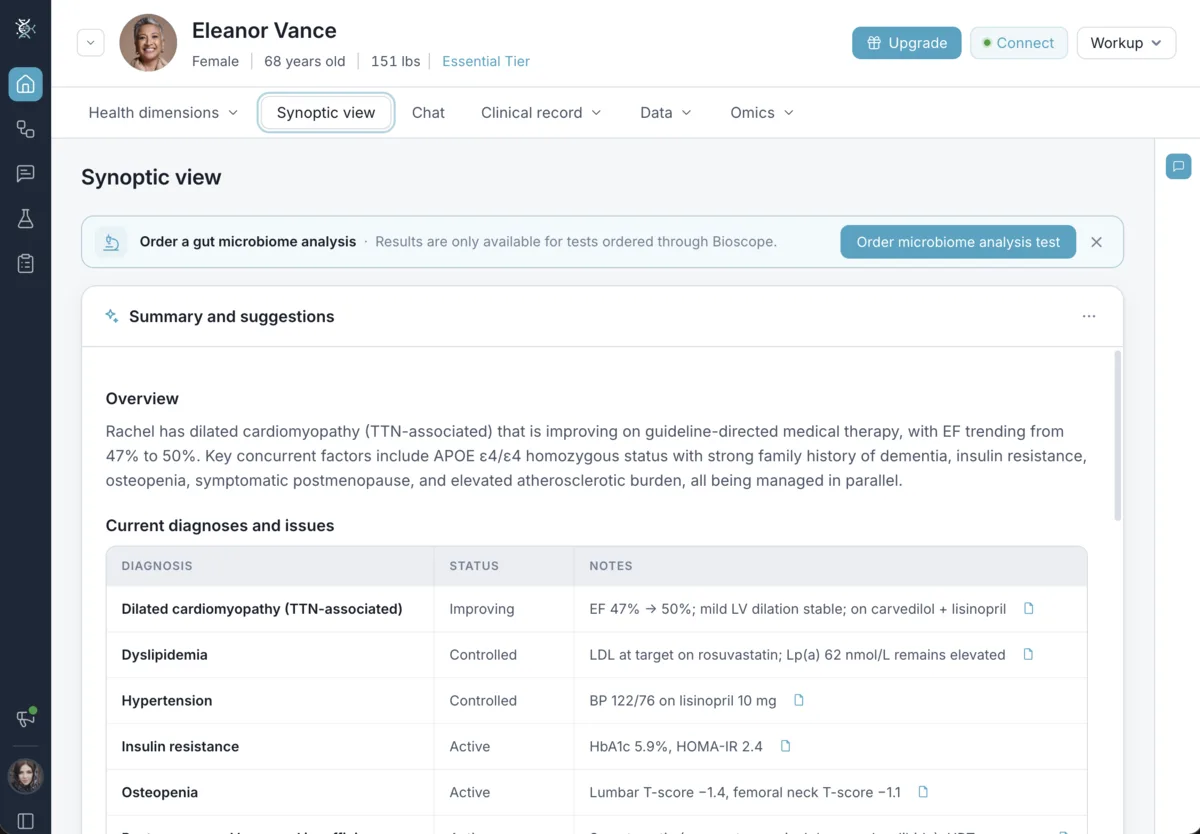
Bioscope.ai helps physicians review biomarkers and laboratory information as part of the patient's connected health profile. Instead of treating each report as a separate event, the platform supports a more structured examination of how the patient's data fits together.
This can help physicians prepare more efficiently for follow-up visits and focus the clinical conversation on meaningful changes rather than reviewing every result from the beginning.
The physician remains responsible for interpreting those changes and determining their clinical relevance. Bioscope.ai supports that process by making the patient's available information easier to review in context.
Connect Interventions With What Changes Next
Longevity programs often involve a sequence of physician-directed decisions followed by continued observation.
Depending on the patient and the practice, this may include changes involving nutrition, exercise, sleep, stress management, medications or other appropriate interventions. New laboratory results and patient-reported information may then become available at a later stage.
If each part of that process is documented separately, it can be difficult to understand what changed after an intervention and which areas may require further review.
Bioscope.ai helps maintain a connected record of the patient's clinical context. Physicians can revisit relevant information when assessing follow-up results and preparing the next discussion with the patient.
This creates a clearer workflow for asking important questions:
The platform does not claim that a particular intervention caused a specific result. It helps physicians examine the available information while keeping clinical interpretation and decision-making in their hands.
Add Genomic Context to Long-Term Health Planning
Genomics can contribute useful context to longevity and preventive medicine, but genetic findings should not be interpreted in isolation.
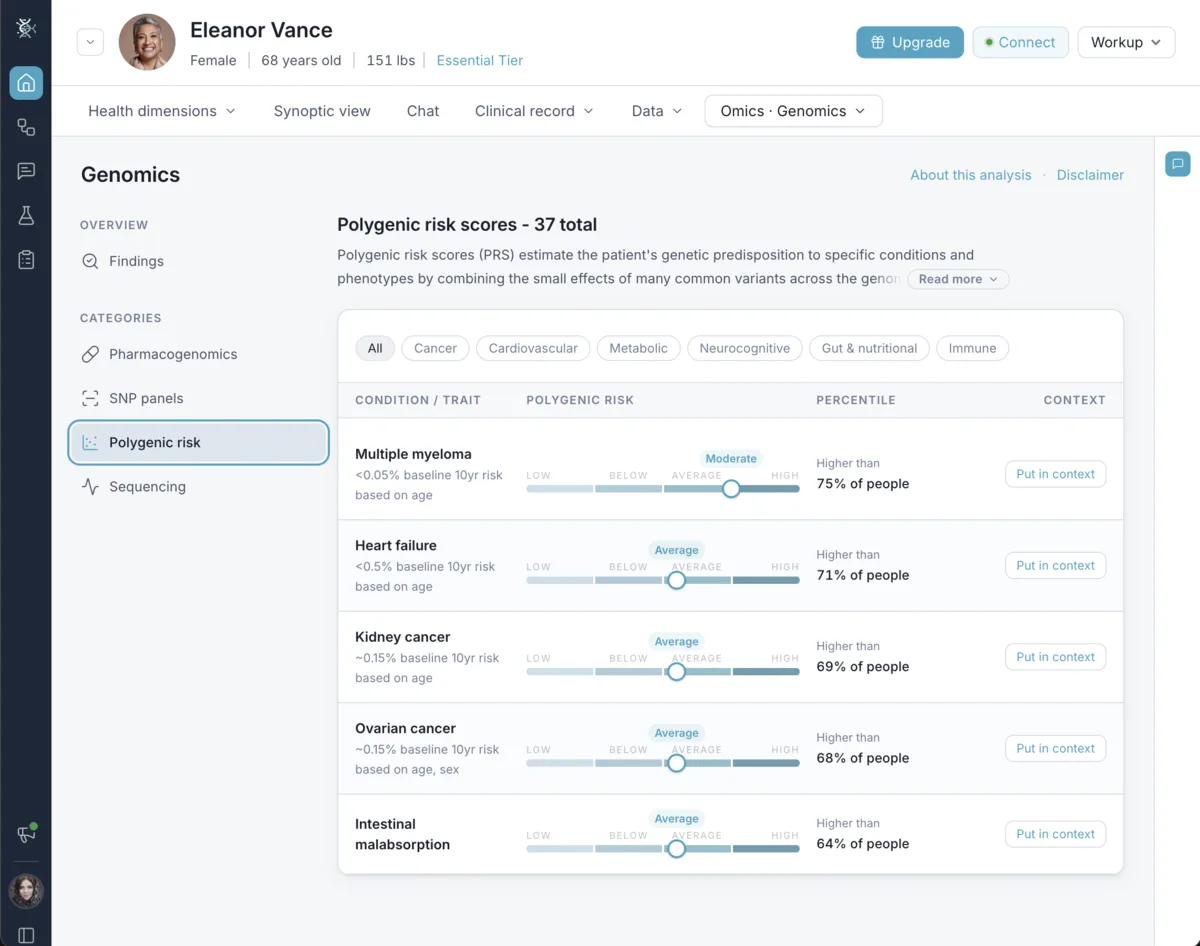
A genetic variant or polygenic risk signal does not describe the patient's complete health trajectory. Its relevance may depend on medical history, family history, laboratory findings, medications, lifestyle, environmental factors and other clinical information.
Bioscope.ai helps physicians review genomic insights alongside the rest of the patient's health data. This connected approach can support a more responsible discussion of inherited risk and personalized prevention without presenting genetic information as a fixed prediction.
For longevity practices, genomic context may help identify areas that deserve closer attention or continued monitoring. It may also support more informed conversations about risk, prevention and the limits of what genetic information can determine.
The platform is designed to assist physician review. Genetic findings, risk estimates and related information must still be interpreted by a qualified professional within the patient's complete clinical context.
Build a More Complete View of Healthspan
Lifespan measures how long a person lives. Healthspan focuses on the years a person lives with better function and health.
Supporting healthspan requires physicians to look beyond one disease category or isolated result. Metabolic health, cardiovascular indicators, cognition, sleep, mobility, inflammation, medications, lifestyle and inherited risks may all contribute to the patient's long-term health picture.
Bioscope.ai helps bring different parts of that picture into a more organized clinical environment. By connecting labs, biomarkers, genomics, microbiome findings, patient history and relevant health context, physicians can review the patient more comprehensively.
This does not produce a guaranteed longevity outcome or a universal healthspan score. It gives physicians a clearer way to examine the information available for an individual patient and use it to support evidence-informed care discussions.
For clinics offering personalized longevity programs, that clarity can help make each follow-up more focused and the patient's long-term direction easier to communicate.
See the Patient's Health Story Over Time
Discover how Bioscope.ai can help your longevity practice connect biomarkers, genomics, laboratory information and patient history in a clearer physician-led workflow.
Request a DemoMake Follow-Up Visits More Focused
Follow-up appointments are central to longevity medicine. They allow physicians to review progress, assess new information and determine whether the patient's care plan still reflects current needs.
However, these visits can become inefficient when the physician must search through previous reports, disconnected notes and multiple clinical systems before understanding what changed.
Bioscope.ai supports a more focused follow-up workflow by organizing relevant patient information into a connected view. Before the appointment, the physician can review available trends, new results and previous clinical context.
During the conversation, this preparation can make it easier to explain:
This helps move the visit away from manually reconstructing the patient's history and toward a more useful discussion about progress, risk and next steps.
Use Wearable Information as Supporting Context
Patients interested in longevity frequently track information outside the clinic. Depending on the devices they use, that information may relate to activity, sleep, recovery or other day-to-day health signals.
Wearable information can add context, but it should not be treated as a substitute for clinical assessment or interpreted separately from the patient's broader health record.
Where supported and appropriately connected, Bioscope.ai can help incorporate relevant wearable information into the patient's wider clinical picture. Physicians can then consider that information alongside laboratory results, biomarkers, history and other available data.
The goal is not to display every metric a device can generate. It is to help the physician identify information that may be relevant to the patient's long-term health discussion.
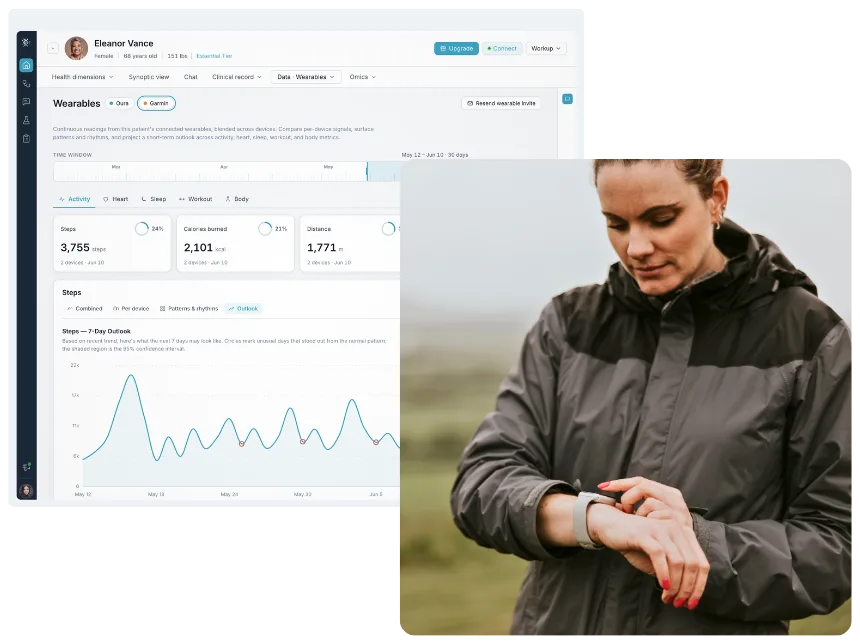
Because integrations and available data can depend on the device, system and Bioscope.ai plan, practices should confirm their required connections during the product evaluation process.
Support Personalized Programs Without Losing Clinical Oversight
Longevity patients often expect care that reflects their individual biology, risks, history and goals. Delivering that level of personalization can become difficult when a practice is working with increasingly complex patient profiles.
Bioscope.ai helps physicians organize the information needed to support more individualized health optimization programs. The platform can bring together multiple categories of patient data and make them easier to review within one clinical workflow.
This can help the physician establish a more structured starting point, revisit the patient's health context as new results arrive and keep future discussions connected to the patient's documented history.
Bioscope.ai does not autonomously diagnose patients or make independent treatment decisions. Its role is to support the physician with organized information and clinical context.
The physician remains responsible for determining whether a finding is relevant, whether additional evaluation is required and which care decisions are appropriate for the individual patient.
Add a Clinical Intelligence Layer to Existing Workflows
Longevity medicine software should not create another isolated location where important patient information becomes trapped.
Bioscope.ai is designed to support clinical review while working alongside the systems a practice already uses. It provides a physician-facing layer for bringing complex health information into a clearer and more useful view.
Depending on the practice's requirements and selected capabilities, this may include connections involving clinical records, laboratory information, genomic results, microbiome findings and supported patient-generated data.
Before implementation, the practice should confirm the integrations, testing services and platform tier required for its workflow.
The purpose is not to replace every clinical or administrative system. It is to reduce the fragmentation that makes longitudinal patient review slower and more difficult.
Give Patients a Clearer Understanding of Their Progress
Longevity patients are often highly engaged with their health information. They may arrive with test results, device data, questions about inherited risk and specific goals for the years ahead.
More information, however, does not always create more understanding.
When results are explained separately, patients may struggle to see which changes matter and how different findings relate to their broader health direction.
A connected clinical view can help physicians communicate progress more clearly. Rather than presenting a collection of disconnected numbers, the physician can explain relevant patterns, limitations and priorities within the patient's full context.
This supports a more productive physician-patient conversation while avoiding guarantees about disease prevention, lifespan or treatment outcomes.
Bioscope.ai helps organize the information behind that conversation. The physician remains responsible for its interpretation and for communicating what the available evidence does, and does not, show.
Longevity Medicine Software Built Around Physician-Led Care
Bioscope.ai is built for practices that work with complex health data and need a clearer way to review the patient over time.
For longevity clinics, the value is not simply having access to more information. The value is being able to connect that information, understand what changed and prepare for the next physician-led decision.
The platform helps bring together biomarkers, laboratory trends, genomics, microbiome information, medical history and relevant clinical context. This can support more efficient preparation, clearer follow-up conversations and more organized long-term care planning.
Bioscope.ai supports clinical reasoning rather than replacing it. It does not promise longer life, prevent disease automatically or remove the need for professional medical judgment.
It gives longevity physicians a more structured way to work with growing patient data while keeping care personalized, evidence-informed and human.
Turn Long-Term Patient Data Into a Clearer Longevity Workflow
See how Bioscope.ai can help your practice connect biomarkers, genomics, lab information and patient history to support personalized longevity care over time.