Gut Microbiome Testing: Making the Results Relevant to the Patient
A gut microbiome test can generate a large amount of information.
The difficult part is deciding what that information actually means for the person sitting in front of the physician.
Microbiome reports may describe the organisms detected in a sample, overall diversity, and aspects of microbial function. Those findings can be useful, but they do not explain a patient’s health on their own.
Diet, supplementation, medication use, gastrointestinal symptoms, laboratory findings, recent illness, and medical history can all affect how microbiome results should be interpreted.
That makes the microbiome less useful as an isolated report and more useful as one part of a broader clinical conversation.
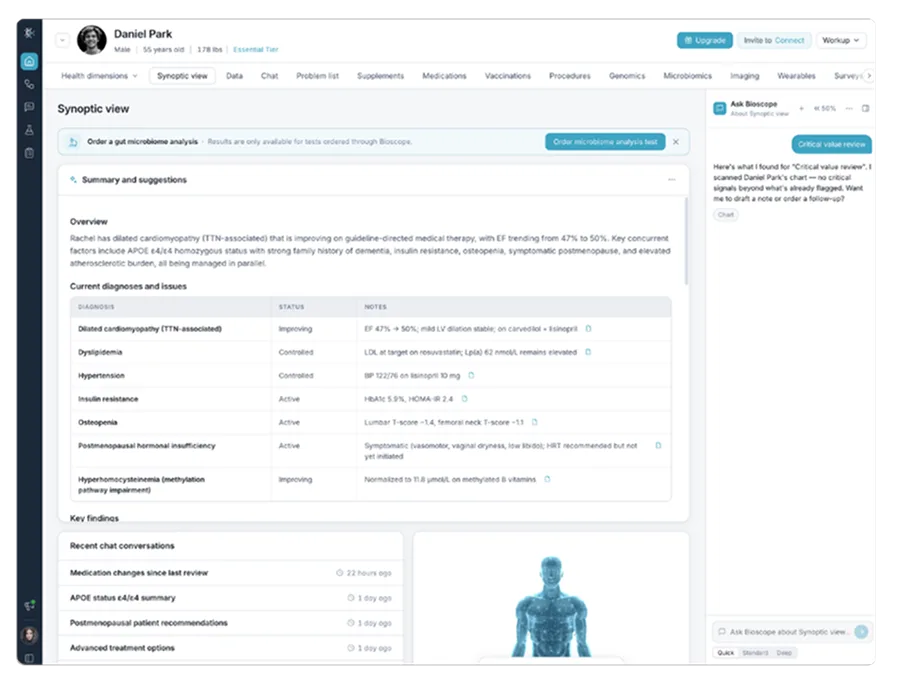
Bioscope.ai already incorporates microbiome testing into its platform, allowing these findings to sit alongside other patient information rather than remaining separate from the rest of the record.
A Microbiome Report Is Only the Starting Point
A report can tell a physician what was measured in a sample.
It cannot automatically explain why a particular pattern appeared or whether that pattern matters clinically.
A patient may have a finding that looks unusual when compared with a reference population, but the interpretation may change when diet, medications, supplementation, symptoms, or recent health events are considered.
That is why the first step after receiving microbiome results should not be to classify the test as “good” or “bad.”
The better question is: how does this result fit with what we already know about the patient?
In some cases, microbiome findings may support an existing clinical picture. In others, they may introduce new questions. Sometimes they may add little beyond what is already known.
The value lies in interpretation rather than simply collecting another dataset.
Why Diet and Supplementation Matter
The gut microbiome is influenced by what a person eats.
Changes in dietary patterns can affect the environment in which microbial communities live, and supplementation may also influence what is observed in a later test.
This means dietary history matters when interpreting microbiome data.
A result may be difficult to understand if the physician does not know whether the patient recently changed their diet, started or stopped supplements, or made other meaningful lifestyle changes.
These factors do not automatically explain every finding, but they provide context that can help avoid overinterpreting a single report.
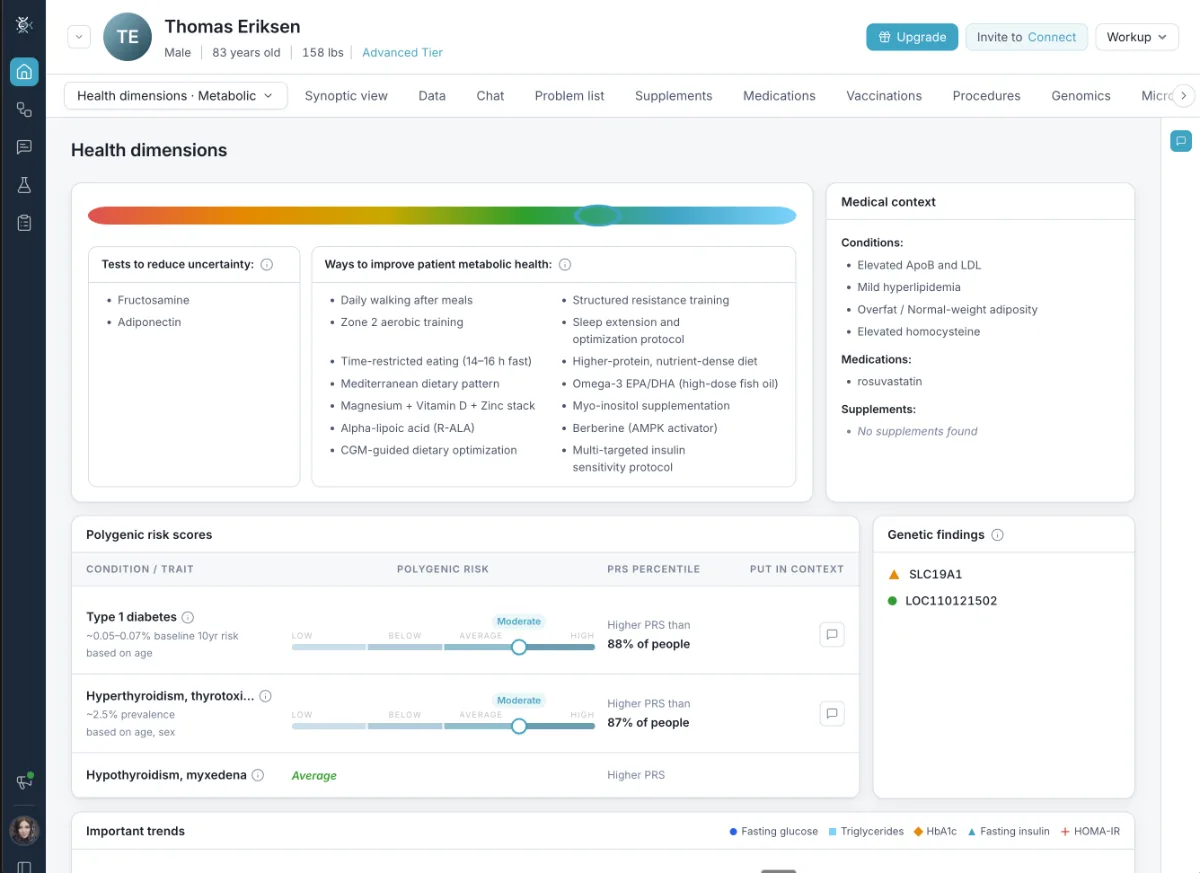
For physicians using integrative medicine software, this relationship is especially relevant because nutrition, lifestyle, symptoms, laboratory data, medications, and other health information often need to be reviewed together.
The microbiome becomes more useful when it is part of that larger view.
Symptoms Can Change How Results Are Read
The same microbiome finding can have different relevance in different patients.
A person with persistent gastrointestinal symptoms may require a different interpretation from someone who is asymptomatic and underwent testing as part of a broader health assessment.
Symptoms can help provide direction.
Changes in bowel habits, abdominal discomfort, bloating, food tolerance, or other concerns may give the physician a reason to examine certain findings more closely.
At the same time, a microbiome report should not be used to force an explanation for every symptom.
The presence of detailed microbial data can create a temptation to connect findings that may not actually be clinically meaningful.
That is why physician judgment remains central.
Microbiome information should support the clinical picture, not replace it.
Medications Belong in the Conversation
Medication history is another important part of interpretation.
A patient may have recently taken antibiotics or started a medication that influences gastrointestinal function or overall health.
Without that information, a microbiome result can easily be viewed in isolation.
The timing of medications may matter just as much as the medication list itself.
Was the test taken during treatment? Shortly after a change? Months later?
These details can affect how confidently a physician interprets the result.
Within functional medicine software, keeping microbiome findings close to medications, symptoms, labs, and other patient history can reduce the need to reconstruct this context manually.
That makes the result easier to place within the patient’s broader story.
What Repeat Testing Can Add
The microbiome can change over time.
That means a single test does not necessarily define a long-term pattern.
If repeat testing is clinically appropriate, comparing results may provide additional information about whether certain findings are persistent, temporary, or changing alongside other aspects of the patient’s health.
The value of repeat testing is not simply having more data.
It is being able to ask better questions.
Did the patient change diet between tests? Were medications different? Did symptoms improve or worsen? Were there changes in supplementation, laboratory markers, or other relevant clinical information?
When repeat results are viewed in this way, the microbiome becomes part of a timeline rather than a static label.
That can make interpretation more meaningful.
See Microbiome Data in Context
Explore how Bioscope.ai brings microbiome findings together with labs, medications, symptoms, and history in one physician-led view.
Schedule a DemoUsing Microbiome Data in Integrative Care
Integrative care often requires physicians to work across different types of information at once.
A microbiome report may sit next to laboratory trends, nutritional history, medications, symptoms, lifestyle information, and other patient-specific data.
The challenge is understanding which relationships matter.
Microbiome testing can contribute to that process by adding another biological signal, but its role should remain proportionate.
The test should not become the center of every clinical decision simply because the report is detailed.
Its value depends on whether the findings help explain, support, or refine the rest of the patient assessment.
This is where integrated workflows become useful.
When relevant information can be reviewed together, the physician is in a better position to decide which findings deserve attention and which may be incidental.
Population Comparisons Are Not the Patient
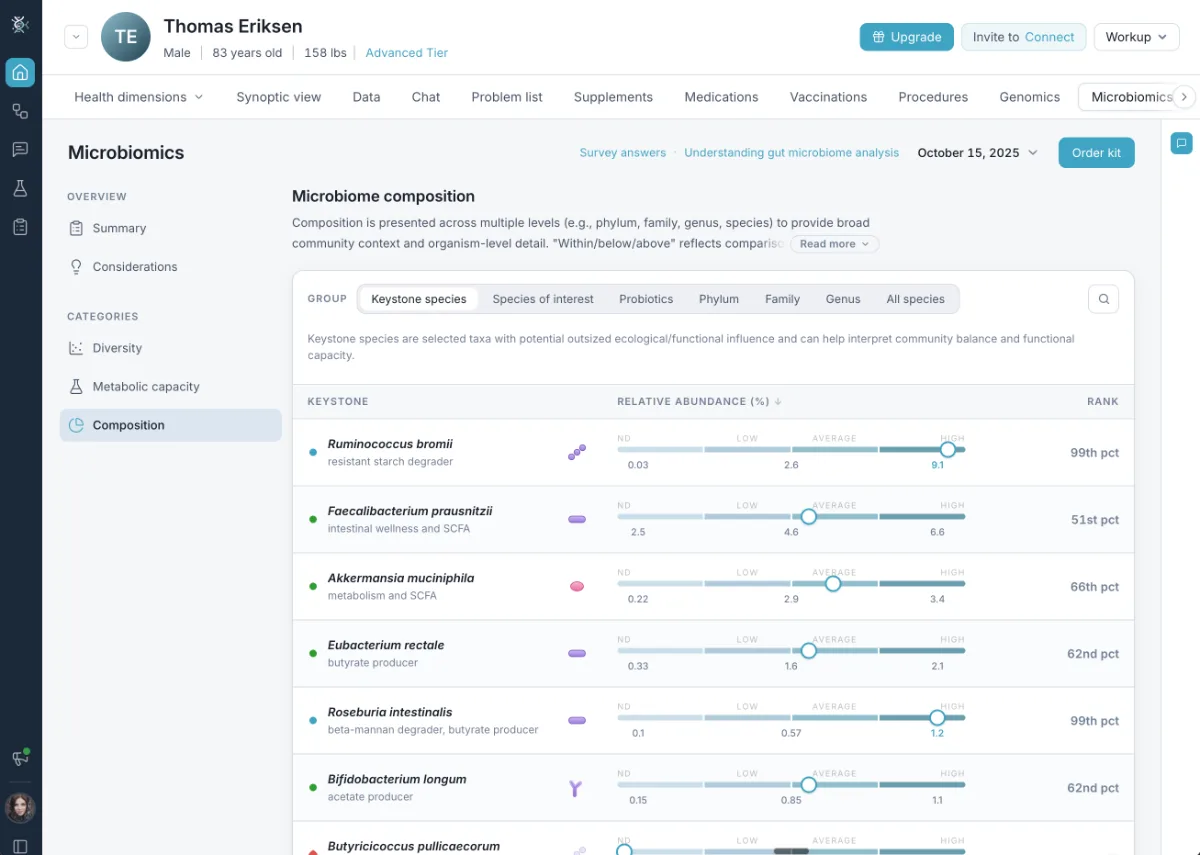
Microbiome testing may compare results with a reference cohort.
That can help show whether certain findings differ from patterns seen in a broader population.
But a population benchmark is not the same as an individual patient.
A deviation from a reference group does not automatically mean that something is wrong.
The physician still needs to understand the patient’s symptoms, history, medications, diet, lifestyle, and other clinical findings before deciding whether the result is meaningful.
This is where precision medicine software for physicians becomes relevant.
Precision medicine is not simply about collecting more detailed biological data. It is about interpreting information in relation to the individual.
Microbiome testing fits naturally within that model when it is treated as one source of evidence rather than a stand-alone answer.
Built for Integrative Practice
See how connected patient data helps physicians decide which findings deserve attention and which may be incidental.
Schedule a Personalized DemoConnecting the Results With the Wider Patient Record
One of the biggest limitations of complex testing is fragmentation.
Microbiome results may live in one report, laboratory data in another system, medication history in the chart, and wearable or genomic data somewhere else.
When those sources are separated, interpretation becomes slower and more difficult.
The physician has to mentally reconstruct the patient's story before deciding what a particular finding means.
Bioscope.ai is designed around a more connected approach.
Microbiome information can be considered alongside genomics, laboratory findings, medications, medical history, wearables, imaging, and other patient data.
This does not mean that every data source needs to be equally important.
It means the physician can see enough of the surrounding context to decide which findings actually matter.
Avoiding Overinterpretation
Microbiome testing is still an area where caution matters.
A report may contain many findings, but the number of findings does not equal the number of clinically actionable conclusions.
Some differences may be meaningful. Others may reflect normal variation, recent lifestyle changes, or factors that are difficult to interpret confidently.
That is why microbiome data should not be treated as a diagnosis.
It should also not be used as a substitute for established clinical assessment.
The most responsible approach is to review the information alongside symptoms, history, medications, laboratory findings, and other relevant evidence.
That helps keep the microbiome in the right role: informative, potentially useful, but not definitive on its own.
From a Lab Report to a Clinical Conversation
The real value of gut microbiome testing begins after the report is generated.
The test can provide information about the microbial environment, but the physician still needs to decide what is relevant to the individual patient.
Diet may help explain one finding. Medication history may clarify another. Symptoms may make a pattern more important, while the absence of symptoms may change how strongly it should be weighted.
Repeat testing may show whether the picture is stable or changing.
Laboratory results, genomics, medical history, and other patient information may add context that the microbiome report cannot provide by itself.
For Bioscope.ai, this is where microbiome testing fits best.
Not as an isolated result, but as one part of a broader physician-led view of the patient.
When the microbiome is interpreted in that context, the goal is no longer simply to describe what is present.
It is to understand whether the result contributes something meaningful to the patient’s overall clinical picture.
See Bioscope.ai in Action
Book a demo to see how Bioscope.ai helps physicians interpret microbiome results alongside the rest of the patient record in one connected view.