Blood Test Analysis Software That Reads Labs Against the Whole Genome
Every lab panel your patient has ever had, from any provider, in any format, from any year, analyzed together with their genome, records, imaging and wearable data. Bioscope.ai shows you what changed, explains why it matters for this specific patient, and cites the evidence behind every finding. You decide the plan.
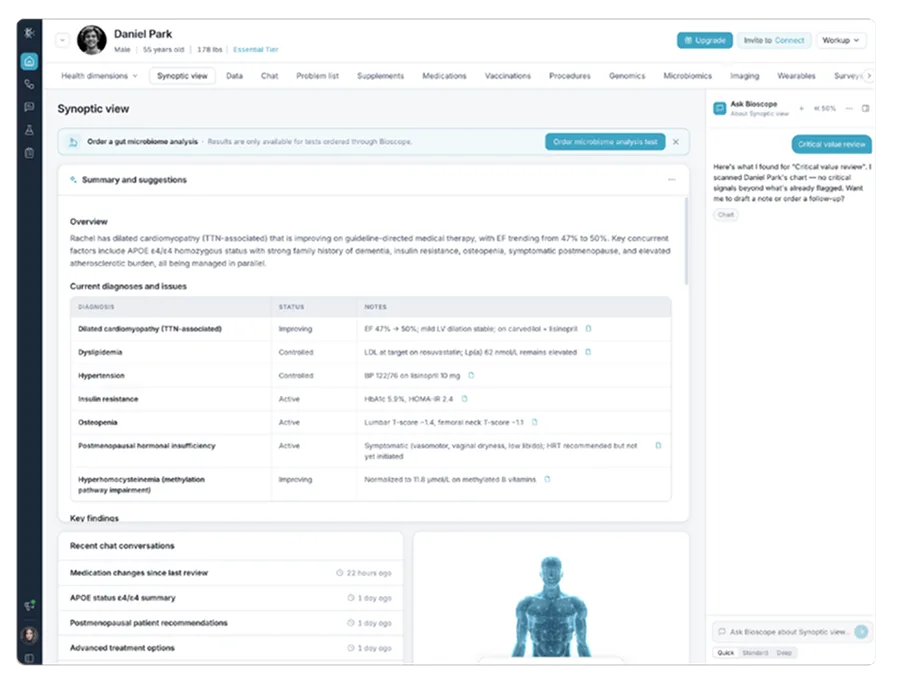
A lab value is a question. The genome is often the answer.
Most blood test analysis software does one thing well: it compares a value to a reference range and colors it red, yellow or green. Some tools add “optimal” ranges that are tighter than the lab’s standard ones. That tells you a marker is off. It does not tell you why.
Why does this patient’s LDL stay elevated despite excellent habits and a statin trial that ended in muscle pain? Why does another patient’s ferritin look normal when their family history says it shouldn’t be? Why has fasting insulin been drifting upward for six years while every individual result stayed inside the normal range?
Those answers rarely sit in the lab report alone. They sit in the combination of the lab value, the patient’s genetic variants, their medication history, their imaging and the trend over time. Bioscope.ai was built to read all of it together as part of one precision medicine platform.
How Bioscope.ai analyzes blood work
Upload any panel, from anywhere
Bioscope.ai accepts lab reports from any laboratory and any provider, whether you ordered them or the patient brought them from a previous physician. Upload a PDF or connect through EHR integration. Panels from different years and different labs become one continuous timeline, so an eleven-year lipid history is as readable as last month’s result.
Trend monitoring with your thresholds
Bioscope.ai tracks every marker over time and flags changes that cross thresholds you define. Set an ApoB target, an A1c ceiling or an Lp(a) screening rule once, and it applies to every patient in your panel. When a value crosses the line, you are notified. When nothing changes, you are not interrupted.
Interpretation informed by the whole genome
This is where Bioscope.ai differs from every lab-only tool. Each patient’s whole genome is sequenced once and included in the price. Lab findings are then read against the patient’s actual variants through genetic testing interpretation built into the same record. A SLCO1B1 variant changes what a statin-intolerance history means and which alternatives are safer. An APOE ε3/ε4 genotype changes how aggressively you treat a borderline ApoB. Bioscope.ai surfaces those connections so you can act on them, with pharmacogenomic guidance when a medication decision is involved.
Every finding cited
Each interpretation links to the peer-reviewed literature and the patient’s own data behind it. Nothing reaches you without a source. Ask a question about a result and you get a deterministic answer: the same record, the same question, the same answer, with multiple models checking each other before anything is shown to you.
Panel-wide alerts
If you want to know about every patient in your practice with an ApoB above your target, Bioscope.ai can notify you across your entire panel. Standing questions are saved once and applied to every chart, never retyped.
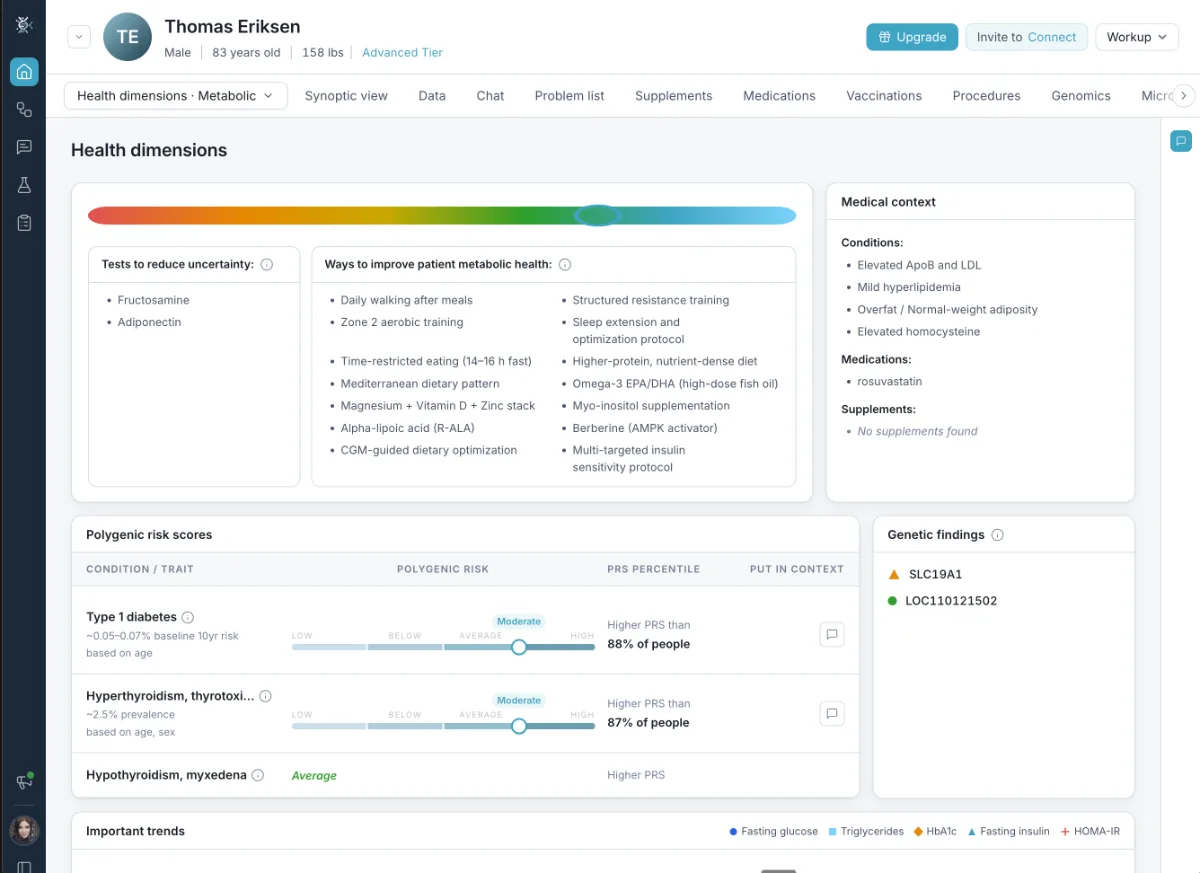
What changes when the genome is in the room
Consider a 58-year-old woman with an ApoB of 96, an A1c of 5.8%, an APOE ε3/ε4 genotype, documented statin intolerance, a family history of coronary disease and eleven years of lab history.
A conventional lab report shows an ApoB that is “borderline” and an A1c that is “pre-diabetic.” A functional report tightens the ranges and colors both yellow. Neither tells you what to do next.
Bioscope.ai reads the same two values alongside her APOE status, her statin history and her family history, and shows you the trajectory of her ApoB over eleven years rather than a single point. It flags that her genetic cardiovascular risk is higher than her lab values alone suggest, surfaces non-statin options consistent with her genotype and tolerance history, and cites the evidence for each. You decide whether to order an Lp(a), start ezetimibe, or tighten follow-up. The platform drafts; the physician decides.
That is the difference between a lab report and a lab analysis. See more examples in our case studies.
Built for how you practice
Longevity, concierge, functional and integrative physicians do not interpret labs the same way, and your method is part of why patients chose you. Bioscope.ai takes the shape of your practice.
Upload a protocol, a patient-facing deck or a recording of yourself talking through a case. Those become the rules Bioscope.ai works from: when Lp(a) gets screened, what counts as an ApoB target, which risks you treating a decade early. Your thresholds and your language are applied consistently across your whole panel, so the patient you see at 4 PM gets the same standard of analysis as the patient at 9 AM.
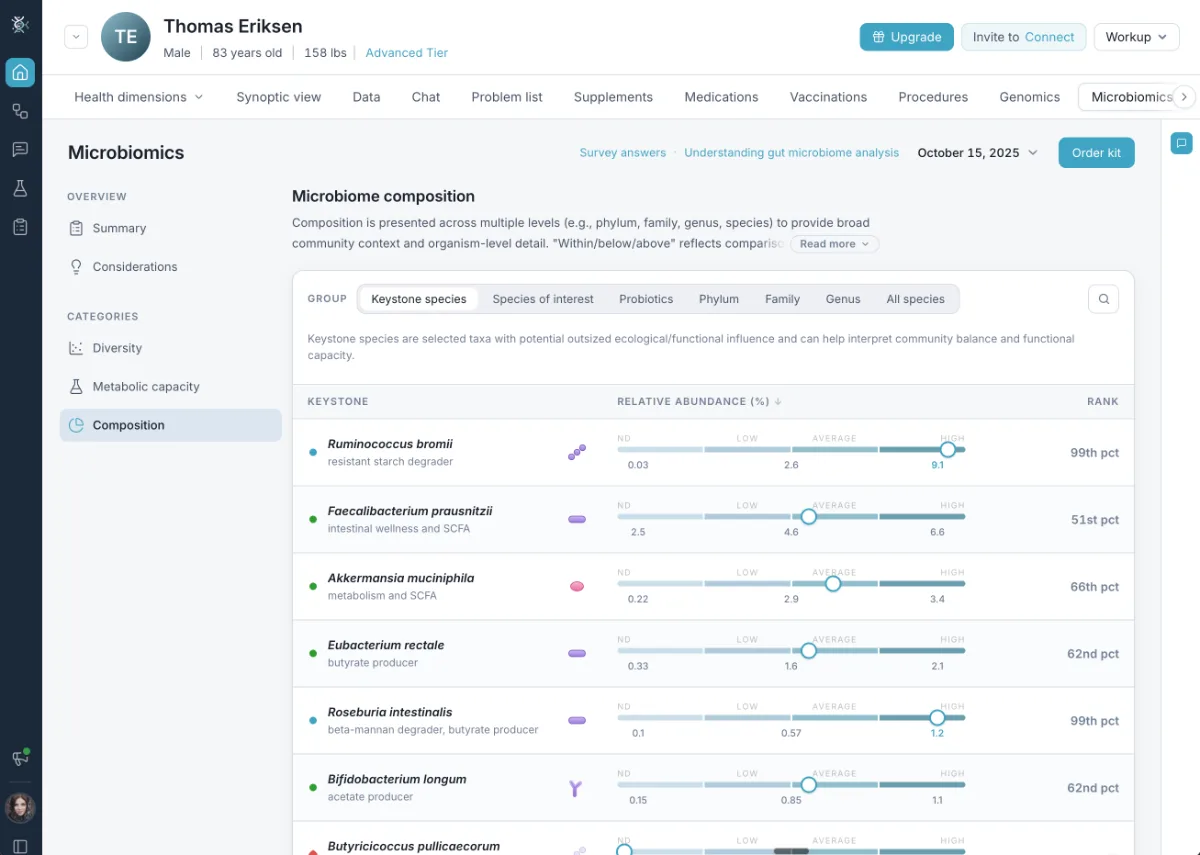
Labs are one input. The platform reads five.
Blood work is the most common data source in a longevity practice, but it is rarely the only one. Bioscope.ai analyzes labs together with:
- The whole genome, sequenced once and re-evaluated against new research for the rest of the patient’s life. Learn more about whole-genome insights.
- Records and history, including prior visits, medications and family history
- Imaging, from whole-body MRI and brain volumetrics to coronary CT and DEXA
- Wearables, covering sleep, training load and glucose across the days between visits, including heart rate variability
- Microbiome, mapped against what the patient actually eats and takes, through gut microbiome analysis
Inputs are more powerful together than one at a time. The genome explains what the labs keep showing. The wearable data gives a lab trend a timeline. Considered together, they describe this patient rather than a population average, which is the foundation of the patient digital twin.
The time problem lab analysis software should actually solve
A longevity panel often runs dozens of markers. Multiply that by the years of history a patient brings and the pre-visit review becomes the most expensive part of the appointment, done at your desk, unpaid, usually at the end of the day. Tools that only reformat the report do not shorten that work; they change its appearance.
Bioscope.ai does the synthesis before you open the chart: trends calculated, thresholds checked, genetic context attached, sources linked. Your work shifts from assembling the picture to verifying it. The result is a shorter pre-visit review and a standard of analysis that does not depend on which clinician is reading or how many patients came before. This is how AI clinical workflow should work: less assembly, more medicine.
From analysis to action
Bioscope.ai prepares you for the visit, answers questions in the room and drafts the follow-up action plan. Outputs come back cited and matched to your protocols as clinical decision support, not as a replacement for it. You review, edit and approve before anything is sent, and you decide what the patient sees. Your method does not change. Your reach does.
Take the product tour
Walk through lab analysis, genetic context and cited findings.
Schedule a Personalized DemoSecurity and compliance
Bioscope.ai runs on HIPAA-compliant infrastructure that is encrypted end to end, audit-logged and covered by a signed Business Associate Agreement. AI processing of protected health information occurs only through HIPAA-compliant services. Only de-identified, aggregated data may be used to improve the platform, in accordance with applicable law. Full details are available in our security documentation.
Getting started
Bioscope.ai reads lab reports from any laboratory, uploaded as PDFs or connected through your EHR, and historical panels from previous providers can be added to build a complete timeline. Your thresholds and reference ranges are configured once and applied across your entire panel. Whole-genome sequencing is included for every enrolled patient, sequenced once and never billed again, and lab interpretation becomes significantly more specific once genetic data is available. See how genetic testing works with Bioscope.ai.
Pricing is one annual fee per enrolled patient, with sequencing included. Nothing per seat, nothing per report. Your whole team can access every enrolled patient. And at every step, the physician decides the plan and what the patient sees.
See your own labs analyzed
The most honest test of a lab analysis tool is to run it on a panel you have already interpreted yourself and compare what it finds to what you found. Bioscope.ai lets you do exactly that, with your own data, before you enroll a single patient.
Try it on yourself
Run Bioscope.ai on a panel you have already interpreted and compare what it finds to your own read, before enrolling a single patient.