Continuous Glucose Monitoring: What Happens Between the Lab Results
A fasting glucose result captures a moment. Continuous glucose monitoring captures what happens around it.
That difference is important. Glucose does not remain fixed throughout the day. It moves in response to meals, physical activity, sleep, stress, medication, illness, and normal physiological variation. A continuous glucose monitor, or CGM, records those changes repeatedly, creating a time-based view that cannot be reproduced by an occasional measurement alone.
For physicians, the benefit is not simply having hundreds or thousands of additional readings. More measurements only become useful when they help answer a clinical question.
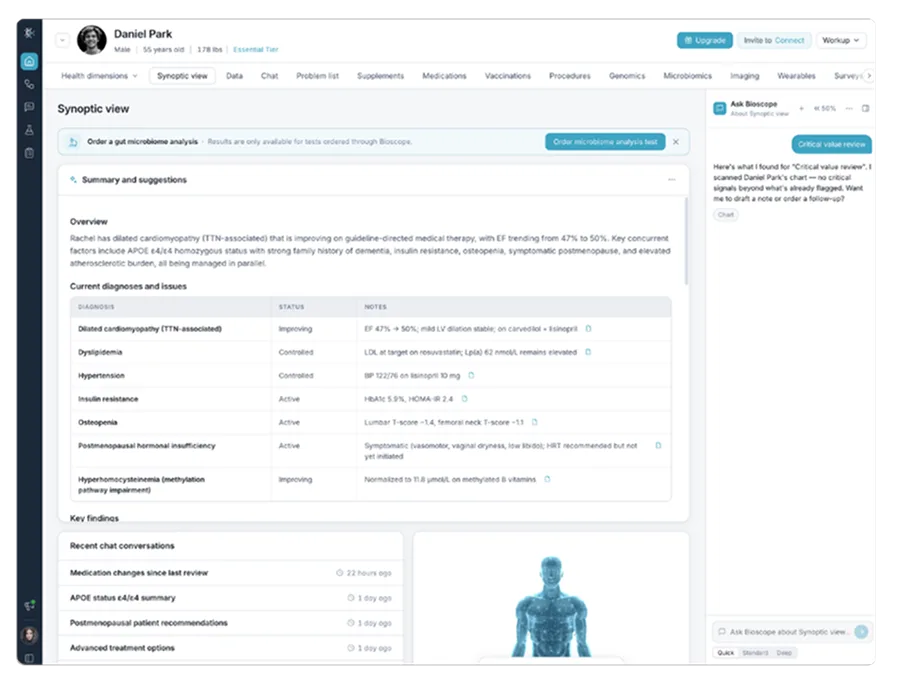
Bioscope.ai already treats glucose as part of the information generated between appointments. Its homepage describes wearable data as capturing sleep, training load, and glucose during the many days when the physician is not seeing the patient. Its Science section places CGMs alongside watches and rings as sources that can contribute clinical signals to a broader patient view.
A Time Series Tells a Different Story
Traditional measurements are often snapshots.
A laboratory value can be highly important, but it reflects a specific point in time and a specific set of conditions. CGM data adds another dimension by showing how glucose behaves across hours, meals, activity periods, sleep, and repeated days.
This does not automatically make continuous data superior. It makes it different.
A physician may be able to see whether a pattern appears repeatedly, whether glucose behaves differently on active and sedentary days, or whether changes occur around specific parts of a patient’s routine. The resulting picture is less about one number and more about variability, timing, and direction.
That is the key distinction. CGM data is a sequence rather than an isolated result.
Patterns Need an Explanation
A graph can make a glucose rise look immediately significant. Clinically, the explanation is rarely that simple.
Food intake matters. Exercise matters. Sleep can matter. Medications, illness, stress, and individual physiology can influence the pattern as well. Without that surrounding information, a curve may be easy to see but difficult to interpret responsibly.
This is why the practical value of CGM depends on context.
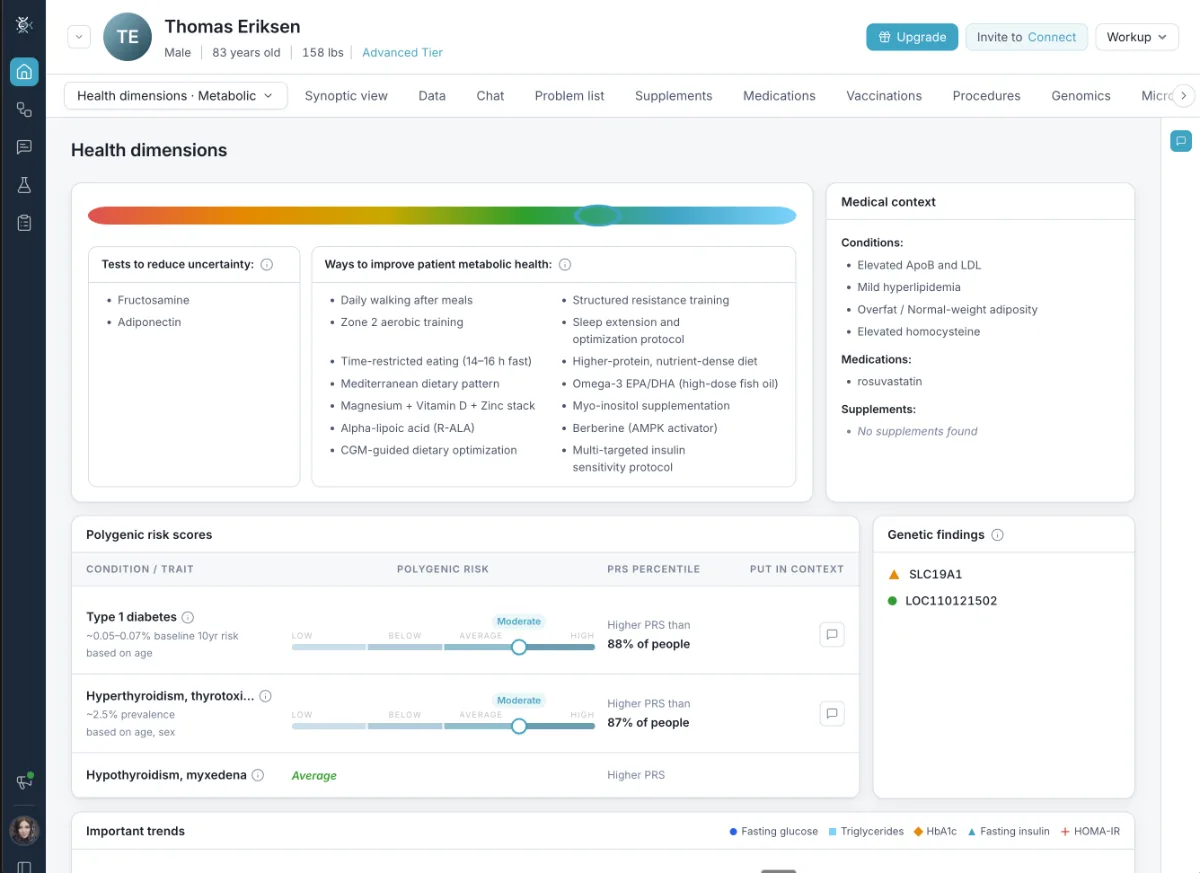
A physician reviewing a recurring glucose pattern may also want to see laboratory history, medications, symptoms, activity, sleep, and other relevant information. A change becomes more meaningful when there is enough evidence to understand what else was happening at the same time.
Bioscope.ai’s broader model is built around this principle. The platform emphasizes bringing different patient signals together rather than asking the clinician to interpret each source separately.
Where Clinical Decision Support Becomes Relevant
Continuous streams can create a new problem: there may be too much information to review efficiently.
This is where clinical decision support software has a natural role.
The objective is not for software to turn a CGM trace into an automatic diagnosis or treatment decision. Bioscope.ai positions decision support around helping physicians review biomarkers, laboratory trends, genomics, microbiome information, medications, history, and other clinical factors in a clearer workflow while keeping medical judgment with the clinician.
CGM data can contribute to that process by adding information about what happened outside the clinic.
A physician may already know the patient’s laboratory values and medication list. Continuous glucose data adds another layer: how metabolic patterns behave through daily life.
The more useful question becomes not “Was glucose high at this moment?” but “Does this pattern fit with everything else we know about this patient?”
Daily Life Is Part of the Dataset
One reason CGM is distinctive is that it records physiology while life is actually happening.
Patients eat differently from one another. They train at different times, sleep for different durations, take different medications, and experience different levels of stress. These conditions are difficult to recreate from an office visit alone.
A continuous monitor can make some of those daily responses visible.
For an integrative medicine software workflow, this can be relevant because physicians may be considering lifestyle, symptoms, laboratory findings, medical history, medications, and other factors together.
The glucose trace is not the whole story. It is another way of seeing how the patient responds outside the appointment.
That distinction helps keep CGM in the proper role. It provides observational data. The physician determines whether those observations are important.
Not Every Excursion Is a Clinical Event
The visibility created by continuous monitoring can also encourage overinterpretation.
When every fluctuation is displayed on a graph, normal variation can begin to look abnormal. A temporary rise does not automatically indicate disease. A flatter trace does not automatically mean that overall metabolic health is optimal.
CGM should therefore be interpreted with caution.
The patient’s diagnosis, medications, symptoms, laboratory results, health history, and reason for monitoring all influence how the data should be understood. Consumer-facing summaries or isolated thresholds cannot replace that clinical context.
This is especially important when continuous glucose monitoring is used outside traditional diabetes management. The presence of more detailed data does not remove the need for evidence-based interpretation.
See the Full Patient Picture
Explore how Bioscope.ai brings glucose, labs, and wearable signals into one clinical view.
Schedule a DemoThe Value of Repeated Observation
The strongest feature of continuous monitoring is not any single reading. It is repetition.
Repeated observation can reveal whether a response happens occasionally or consistently. It can help distinguish a one-off event from a recurring pattern. Over longer periods, it may also show whether a pattern changes after a change in routine, medication, activity, or another relevant factor.
That makes CGM particularly compatible with longevity medicine software, where the emphasis is often on following health across time rather than evaluating only isolated encounters.
Metabolic health is one component of that larger picture.
A glucose pattern may be considered together with body composition, cardiovascular information, laboratory trends, sleep, physical activity, and other relevant signals. None of these alone defines longevity. Together, they can provide a richer view of change.
A CGM Does Not Replace Laboratory Testing
Continuous monitoring and laboratory testing answer different questions.
A CGM is designed to show glucose behavior across time. Laboratory testing can provide standardized measurements that remain important for diagnosis, monitoring, and clinical decision-making.
The two should not be treated as interchangeable.
Instead, continuous data can complement established clinical information when there is a clear reason to review both. If a pattern observed on CGM aligns with laboratory findings or other patient data, the physician has additional context. If they do not align, that difference may itself deserve closer examination.
The value comes from comparison and interpretation, not from assuming that one source should override another.
Review Data With Context
Learn how decision support helps physicians connect continuous data to the rest of the record.
Schedule a Personalized DemoTurning a Stream Into Something Clinically Useful
Wearables have made it possible to collect more health information than most clinicians could realistically review one measurement at a time.
The challenge has shifted from collection to synthesis.
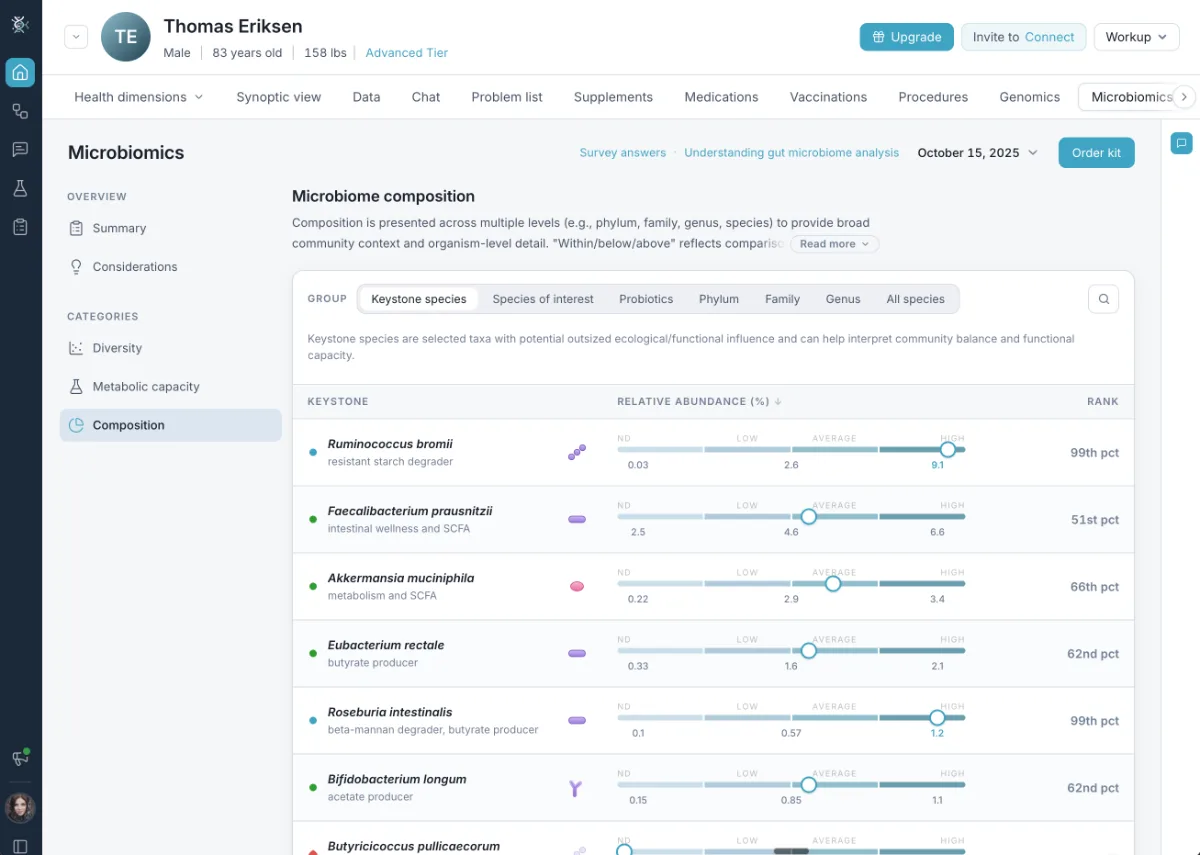
Bioscope.ai’s Science page describes wearables, genomics, microbiome data, imaging, and the medical record as distinct streams that are modeled separately and then reasoned across together. CGMs fit directly within that model as one of the wearable sources capable of contributing clinical signals.
This approach matters because a glucose trace does not become clinically useful simply because it exists.
Someone still needs to understand why the pattern occurred, whether it is consistent with other evidence, and whether it changes the clinical picture.
For Bioscope.ai, CGM data is therefore most valuable not as a stand-alone dashboard but as part of a wider patient record. Continuous monitoring fills in some of what happens between visits. Labs, medications, history, imaging, genomics, microbiome information, and the physician-patient conversation provide the rest of the context.
The result is a more practical use of continuous data: not watching every fluctuation, but helping physicians identify which patterns may actually deserve their attention.
See Bioscope.ai in Action
Book a demo to see how Bioscope.ai helps physicians turn continuous patient data into clear, clinically useful insight between appointments.