Coronary Calcium Score Analysis, Read With the Labs and the Genome
A coronary calcium score is one of the strongest individual markers of cardiovascular risk a physician can order. Bioscope.ai places that score next to everything else that determines what it means for this patient: ApoB and Lp(a) trends, APOE and statin-metabolism variants, family history, blood pressure and wearable data. Every finding is cited. You decide the plan.
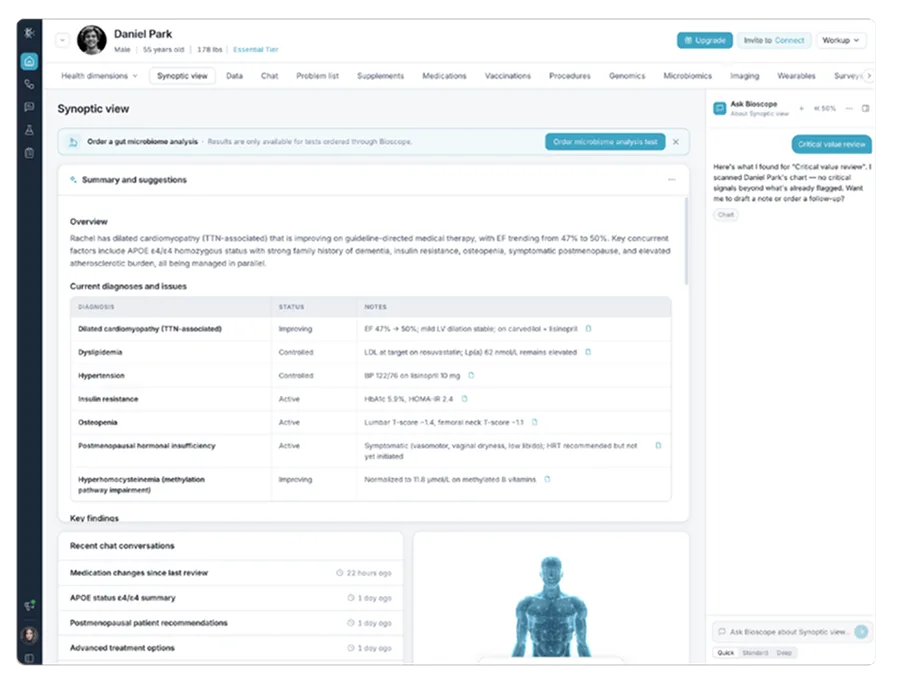
The score answers one question. Your patient has several.
A coronary artery calcium score quantifies calcified plaque in the coronary arteries from a non-contrast CT scan and reports it as an Agatston score, usually with an age- and sex-matched percentile. A score of zero is reassuring. A score above zero in a young patient is significant. A score above 400 changes the conversation entirely.
But the score alone does not tell you how aggressively to treat, which therapy fits this patient, or how to weigh it against the rest of their picture. A CAC of 80 in a 49-year-old woman with an Lp(a) of 180 nmol/L, an APOE ε3/ε4 genotype and a father who had a heart attack at 55 is a very different finding from the same score in a 68-year-old man with none of those factors. The radiology report cannot see that difference. The rest of the record can.
Bioscope.ai reads coronary calcium results together with the patient’s labs, genome, history and wearables, so the score becomes a decision point rather than an isolated number. It is one part of a broader precision medicine platform built for exactly this kind of multi-source reasoning.
How Bioscope.ai analyzes a coronary calcium score
Scored against population norms
Coronary CT results are scored against population norms and placed in the patient’s record alongside their other data, not in a separate imaging portal. You see where the score sits relative to age- and sex-matched expectations, and you see it next to the lipid history that explains it.
Read with the lipid labs
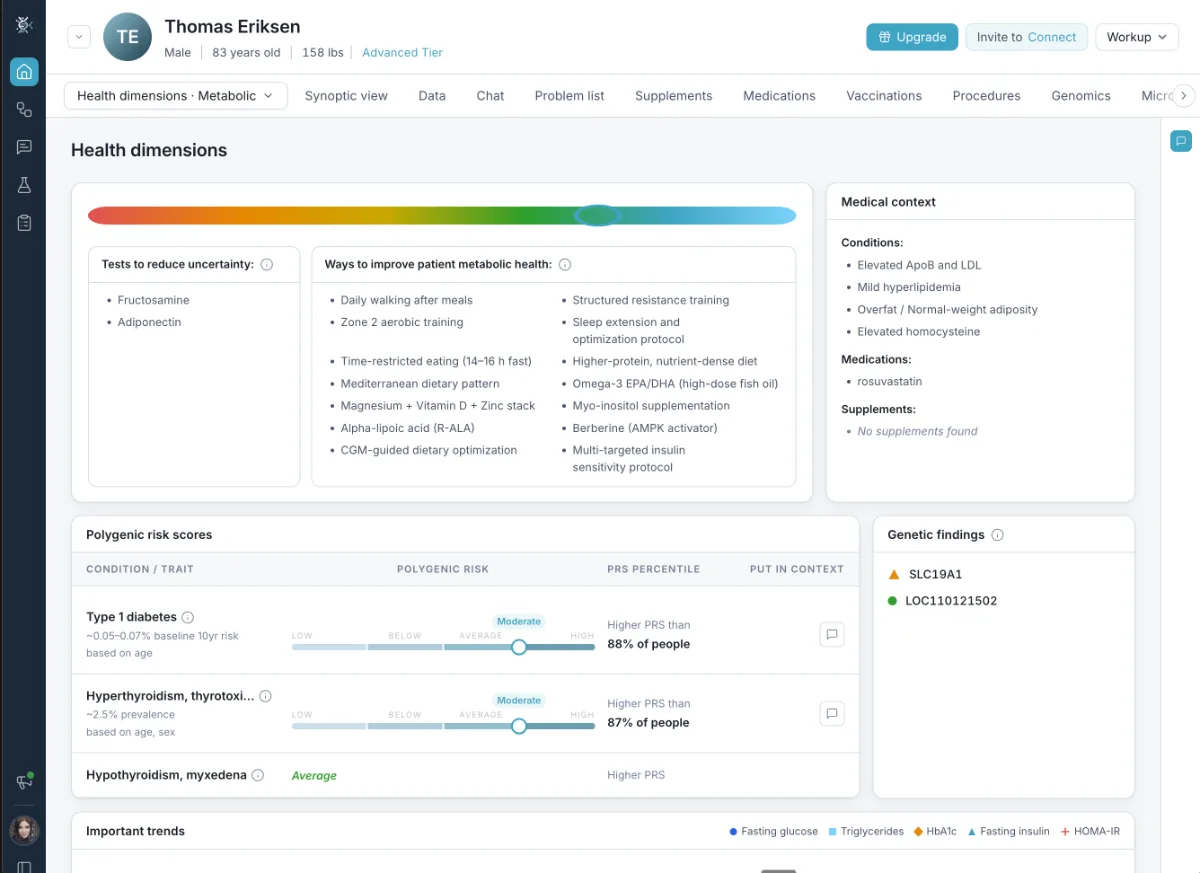
Bioscope.ai holds every lab panel the patient has ever had, from any provider, in any format, from any year. A calcium score is interpreted alongside the full ApoB trajectory, LDL history, Lp(a) result and inflammatory markers, not a single recent value. If Lp(a) has never been measured, that gap is visible. If ApoB has drifted upward over a decade while each result stayed “borderline,” the trend is visible. Learn how Bioscope.ai handles lab analysis in the same record.
Read with the genome
Each enrolled patient’s whole genome is sequenced once and included in the price. Calcium score findings are interpreted in light of the patient’s actual variants through genetic testing interpretation built into the same record. APOE genotype changes how much weight a borderline score carries. A SLCO1B1 variant changes which statin is safe and which alternatives to consider, with pharmacogenomic guidance available when the medication decision arrives.
Your cardiovascular protocol, applied to every chart
Upload your protocol, or a recording of yourself talking through a cardiovascular case, and it becomes the rule Bioscope.ai works from: when Lp(a) gets screened, what counts as an ApoB target, at what calcium score you intensify therapy, which risks you treat a decade early. The same standard is applied to every patient in your panel.
Panel-wide alerts
If you want to know about every patient with a positive calcium score and an ApoB above your target, or every patient over 45 with a family history who has never had Lp(a) measured, Bioscope.ai can surface that across your entire panel. Standing questions are saved once and never retyped.
Every finding cited
Each interpretation links to the peer-reviewed literature and the patient’s own data behind it. Ask a question about a calcium score and you get a deterministic answer: the same record, the same question, the same answer, with multiple models checking each other before anything reaches you.
What changes when the record is complete
Consider a 58-year-old woman with a coronary calcium score of 60. Her radiology report places her above the 75th percentile for her age and sex. On its own, that is a finding that warrants attention but leaves the next step open.
In Bioscope.ai, the same result appears next to an ApoB of 96 that has risen slowly over eleven years, an APOE ε3/ε4 genotype, a documented statin intolerance, a family history of coronary disease and an Lp(a) that has never been measured. Each of those inputs is already in her record. Bioscope.ai flags that her genetic and lipid risk is higher than the score alone suggests, notes the missing Lp(a), surfaces non-statin options consistent with her genotype and tolerance history, and cites the evidence for each. You decide whether to order the Lp(a), start ezetimibe, adjust targets or tighten follow-up. The platform drafts; the physician decides.
That is the difference between a calcium score report and a calcium score analysis. See more examples in our case studies.
Built for how you practice
Longevity, concierge, functional and integrative physicians approach cardiovascular prevention differently, and your approach is part of why patients chose you. Bioscope.ai takes the shape of your practice.
Your targets, your screening rules and your language are applied consistently across your whole panel, so the patient you see at 4 PM gets the same standard of cardiovascular analysis as the patient at 9 AM.
Imaging is one input. The platform reads five.
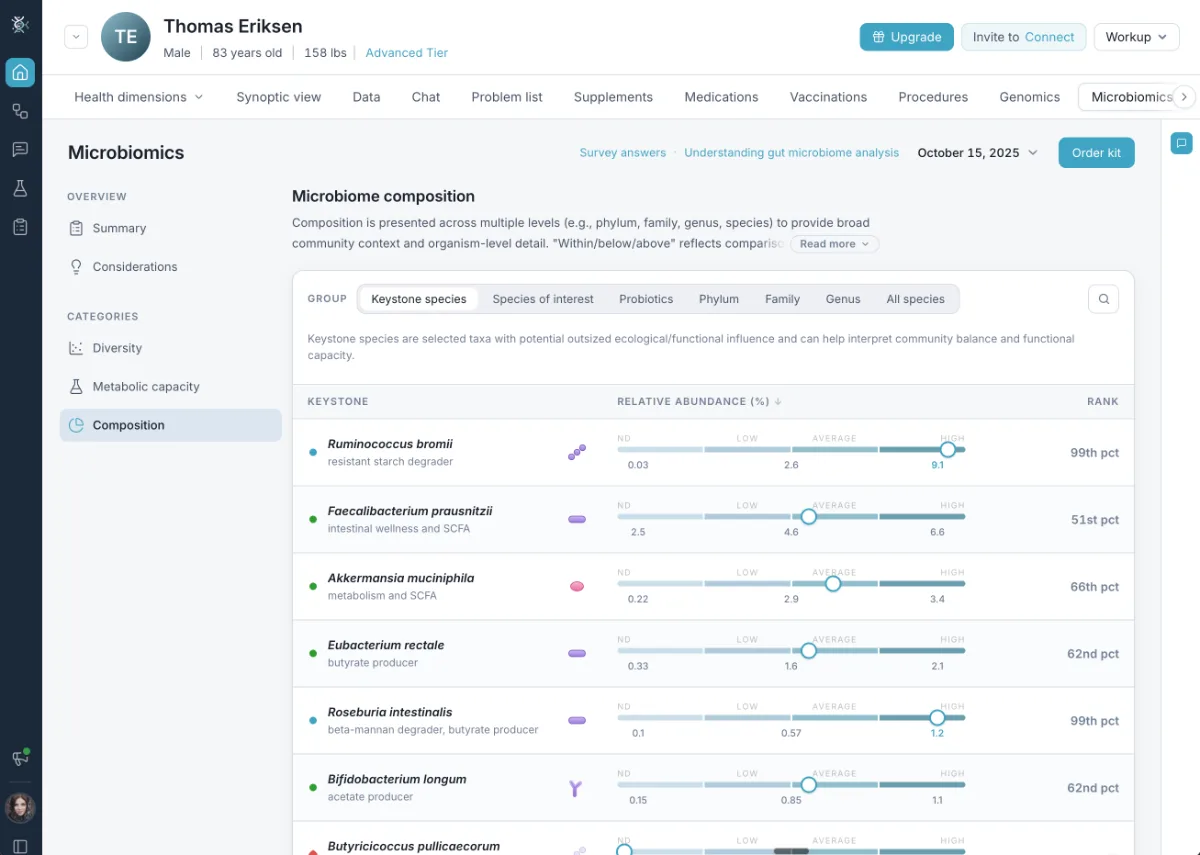
Coronary CT is one of several imaging sources Bioscope.ai integrates, alongside whole-body MRI organ analysis, brain volumetrics and DEXA. Imaging, in turn, is one of five inputs the platform reads together:
- The whole genome, sequenced once and re-evaluated against new research for the rest of the patient’s life. Learn more about whole-genome insights.
- Records and labs, from any provider, in any format, from any year
- Imaging, scored against population norms and integrated with labs and functional data
- Wearables, covering sleep, training load, heart rate variability and glucose across the days between visits
- Microbiome, mapped against what the patient actually eats and takes, through gut microbiome analysis
Inputs are more powerful together than one at a time. The genome explains what the labs keep showing. Wearables give an image a timeline. Considered together, they describe this patient rather than a population average, which is the foundation of the patient digital twin.
Book a demo
Schedule a DemoFrom analysis to action
Bioscope.ai prepares you for the visit, answers questions in the room and drafts the follow-up action plan. Outputs come back cited and matched to your protocols as clinical decision support, not as a replacement for it. You review, edit and approve before anything is sent, and you decide what the patient sees. Your method does not change. Your reach does.
Security and compliance
Bioscope.ai runs on HIPAA-compliant infrastructure that is encrypted end to end, audit-logged and covered by a signed Business Associate Agreement. AI processing of protected health information occurs only through HIPAA-compliant services. Only de-identified, aggregated data may be used to improve the platform, in accordance with applicable law. Full details are available in our security documentation.
Take the product tour
Schedule a Personalized DemoGetting started
Coronary calcium results enter Bioscope.ai with the rest of the patient’s imaging, alongside labs connected through EHR integration or uploaded directly. Whole-genome sequencing is included for every enrolled patient, sequenced once and never billed again, and cardiovascular interpretation becomes significantly more specific once genetic data is in the record. See how genetic testing works with Bioscope.ai.
Pricing is one annual fee per enrolled patient, with sequencing included. Nothing per seat, nothing per report. And at every step, the physician decides the plan and what the patient sees.
See it on your own record
Licensed physicians can run Bioscope.ai on their own health data first, including their own calcium score and lipid history, before enrolling a single patient. It is the most direct way to judge whether the analysis adds something your current workflow does not.
Try it on yourself
Licensed physicians can run Bioscope.ai on their own calcium score and lipid history before enrolling a single patient. Book a demo to see it.