Brain MRI Volumetric Analysis, Read in the Context of the Whole Patient
Neuro-volumetric results scored against population norms and interpreted alongside the patient’s whole genome, lab history, imaging and wearable data. Bioscope.ai places brain volumetrics in the same record as everything else you know about the patient, cites the evidence behind each finding, and leaves the decision to you.
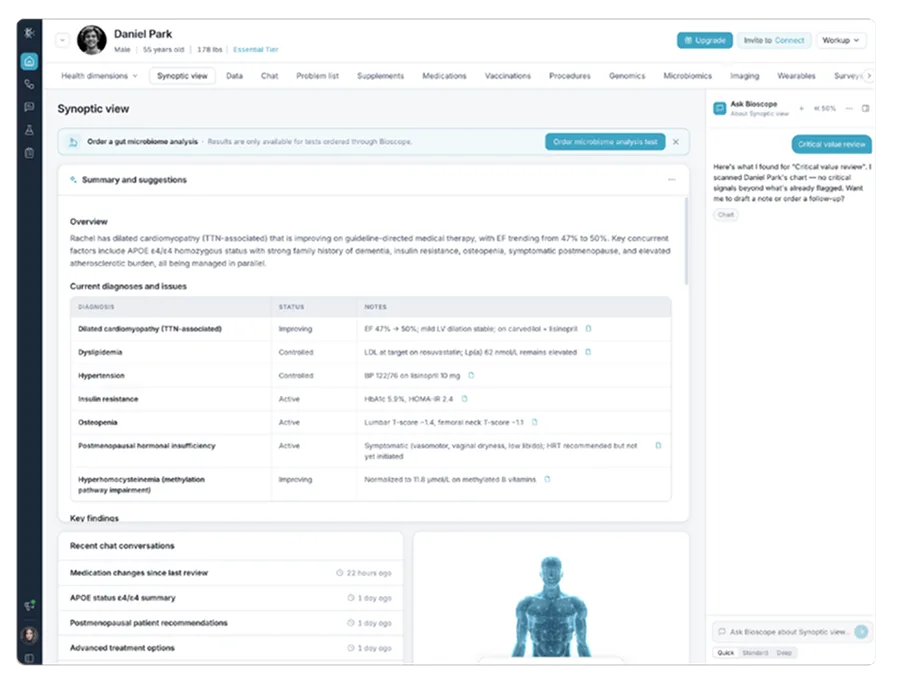
A volume number without context is just a number
Brain MRI volumetric analysis measures the size of specific brain regions, typically the hippocampus, the ventricles, total gray and white matter and cortical thickness, and compares them to what is expected for the patient’s age and sex. The radiology report arrives as a set of percentiles, sometimes with a model-based brain-age estimate attached.
For a physician, the hard part begins after the report. A hippocampal volume at the 30th percentile means something different in a 48-year-old APOE ε4 carrier with rising fasting insulin and poor sleep than it does in a 70-year-old with none of those factors. The report cannot tell you which patient you are looking at. The rest of the record can.
Bioscope.ai reads neuro-volumetric results together with the patient’s genome, labs, medical history and wearable data, so the volume number becomes a finding you can act on rather than a figure you have to interpret alone. It is one part of a broader precision medicine platform built for exactly this kind of multi-source reasoning.
How Bioscope.ai analyzes brain volumetrics
Scored against population norms
Imaging results, including neuro-volumetrics and brain-age estimates, are scored against population norms and placed in the patient’s record alongside their other data, not in a separate imaging portal. You see where a regional volume sits relative to age- and sex-matched expectations, and you see it next to the labs and history that explain it.
Read with the genome
Each enrolled patient’s whole genome is sequenced once and included in the price. Neuro-volumetric findings are interpreted in light of the patient’s actual variants through genetic testing interpretation built into the same record. APOE genotype is the obvious example: the same volumetric result carries a different weight for an ε3/ε4 carrier than for an ε3/ε3 patient, and Bioscope.ai surfaces that connection rather than leaving it for you to remember.
Read with the labs and the wearables
Brain health does not sit in isolation from metabolic and cardiovascular health. Bioscope.ai places volumetric results alongside the patient’s lab trends, such as fasting insulin, A1c, ApoB and inflammatory markers, and alongside wearable data on sleep. When volumetrics, labs and sleep all point the same way, the picture is clearer than any one of them alone. When they disagree, that is worth knowing too. Learn how Bioscope.ai handles lab analysis and heart rate variability in the same record.
Tracked over time
Volumetric imaging is most useful when it is repeated. Bioscope.ai holds results from different dates in one continuous record, so the trajectory is visible, not just the latest snapshot. Scanner, protocol and software differences can affect comparability, and that caveat travels with the data.
Every finding cited
Each interpretation links to the peer-reviewed literature and the patient’s own data behind it. Ask a question about a volumetric result and you get a deterministic answer: the same record, the same question, the same answer, with multiple models checking each other before anything reaches you.
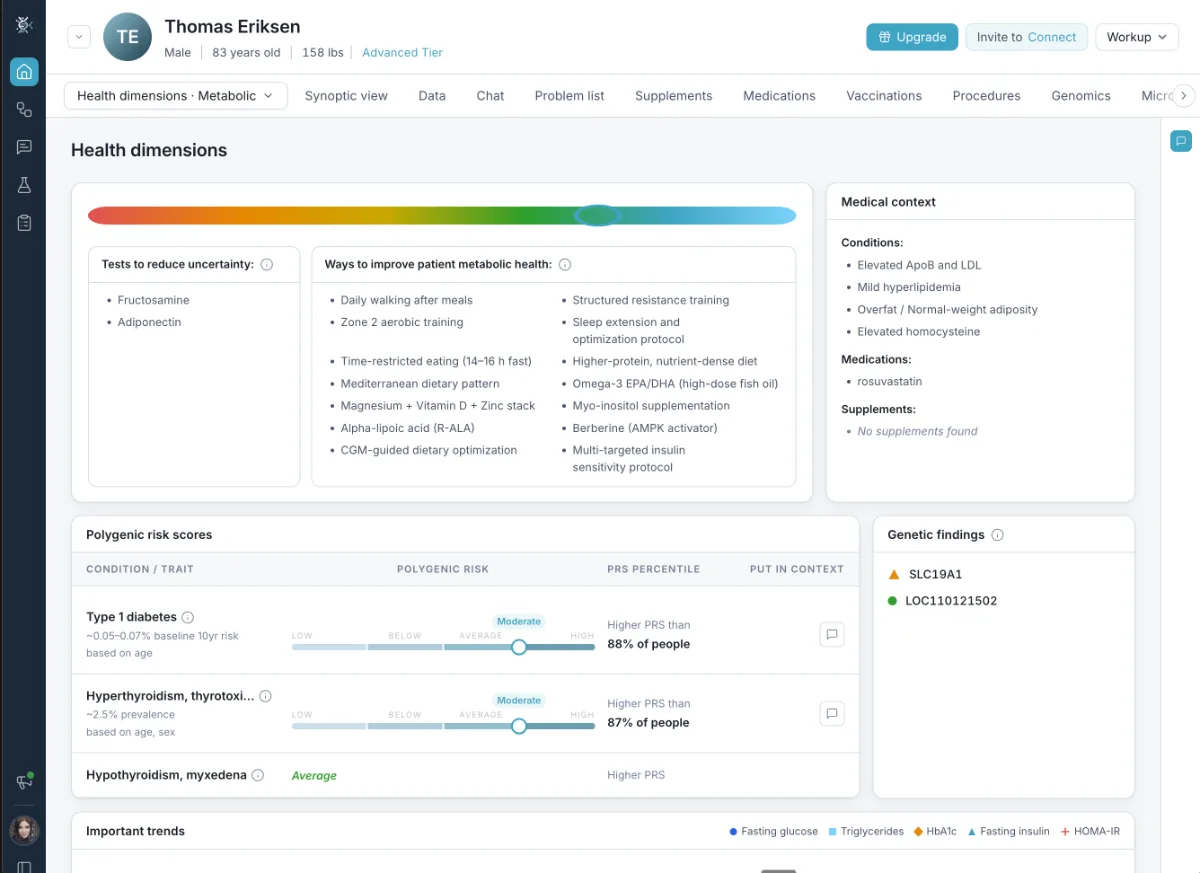
About brain age
Many volumetric reports now include a brain-age estimate: a single number produced by a model trained to predict chronological age from MRI, with the gap between predicted and actual age offered as a marker of brain health.
Bioscope.ai includes brain-age estimates as an input, but treats them as what they are: a model output, not a diagnosis. Published comparisons have found that simple normalized gray-matter and regional volume measures perform at least as well as brain-age models for clinically meaningful outcomes, and that different brain-age packages do not always agree with each other. For that reason, Bioscope.ai keeps the underlying regional volumes visible and in context, rather than reducing brain health to one number. You can see how a brain-age estimate relates to the patient’s biological age markers on the biological age view, with the source data one tap away.
What changes when the record is complete
Consider a 52-year-old man whose volumetric report shows hippocampal volume in the lower range for his age, with everything else unremarkable. On its own, that is an ambiguous finding and a difficult conversation.
In Bioscope.ai, the same result appears next to his APOE ε3/ε4 genotype, a fasting insulin that has drifted upward over four years while staying inside the normal range, an ApoB above your target, and wearable data showing consistently short sleep. None of those inputs is alarming alone. Together, they describe a patient whose modifiable cardiometabolic and sleep factors deserve attention now, and they give you a concrete, evidence-cited basis for the plan you choose. You decide what to order, what to treat and what to tell him. Bioscope.ai assembles the picture and shows its sources.
That is the difference between a volumetric report and a volumetric analysis. See more examples in our case studies.
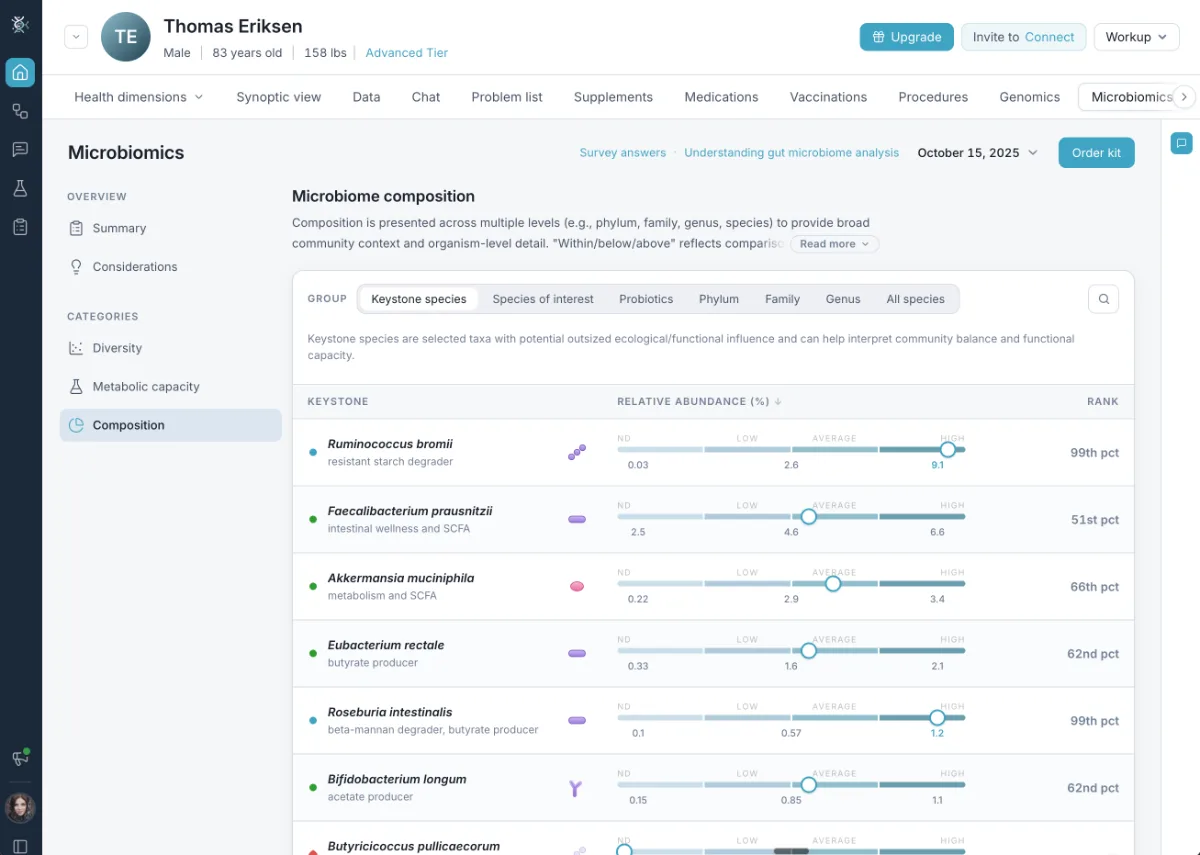
Built for how you practice
Longevity, concierge, functional and integrative physicians approach brain health differently, and your approach is part of why patients chose you. Bioscope.ai takes the shape of your practice.
Upload a protocol, a patient-facing deck or a recording of yourself talking through a case. Those become the rules Bioscope.ai works from: when you order volumetric imaging, how you weigh APOE status, which risks you treat a decade early. Your thresholds and your language are applied consistently across your whole panel.
Book a demo
Schedule a DemoImaging is one input. The platform reads five.
Neuro-volumetrics is one of several imaging sources Bioscope.ai integrates, alongside whole-body MRI organ analysis, coronary CT and DEXA. Imaging, in turn, is one of five inputs the platform reads together:
- The whole genome, sequenced once and re-evaluated against new research for the rest of the patient’s life. Learn more about whole-genome insights.
- Records and labs, from any provider, in any format, from any year
- Imaging, scored against population norms and integrated with labs and functional data
- Wearables, covering sleep, training load and glucose across the days between visits
- Microbiome, mapped against what the patient actually eats and takes, through gut microbiome analysis
Inputs are more powerful together than one at a time. Wearables give an image a timeline. The genome explains what the labs keep showing. Considered together, they describe this patient rather than a population average, which is the foundation of the patient digital twin.
From analysis to action
Bioscope.ai prepares you for the visit, answers questions in the room and drafts the follow-up action plan. Outputs come back cited and matched to your protocols as clinical decision support, not as a replacement for it. You review, edit and approve before anything is sent, and you decide what the patient sees. Your method does not change. Your reach does.
Take the product tour
Schedule a Personalized DemoSecurity and compliance
Bioscope.ai runs on HIPAA-compliant infrastructure that is encrypted end to end, audit-logged and covered by a signed Business Associate Agreement. AI processing of protected health information occurs only through HIPAA-compliant services. Only de-identified, aggregated data may be used to improve the platform, in accordance with applicable law. Full details are available in our security documentation.
Getting started
Volumetric results enter Bioscope.ai with the rest of the patient’s imaging, alongside labs connected through EHR integration or uploaded directly. Whole-genome sequencing is included for every enrolled patient, sequenced once and never billed again, and volumetric interpretation becomes significantly more specific once genetic data is in the record. See how genetic testing works with Bioscope.ai.
Pricing is one annual fee per enrolled patient, with sequencing included. Nothing per seat, nothing per report. And at every step, the physician decides the plan and what the patient sees.
See it on your own record
Licensed physicians can run Bioscope.ai on their own health data first, including their own imaging, before enrolling a single patient. It is the most direct way to judge whether the analysis adds something your current workflow does not.
Try it on yourself
Licensed physicians can run Bioscope.ai on their own health data first, including their own imaging, before enrolling a single patient.